
Healthcare SEO has the same fundamental goal as SEO in other industries: to help search engines find and understand high-quality content, while helping users reach the answers they are looking for as easily as possible.
There is, however, one important difference that sets the optimisation of medical websites apart from SEO in most other industries. When someone is searching for information about symptoms, a diagnosis, medication or treatment, an inaccurate or misleading answer can have far more serious consequences than, for example, choosing a new mobile phone or looking for ideas for decorating a child’s bedroom.
This is why Google applies a particularly high standard to healthcare topics when it comes to content quality, reliability and expertise.
When discussing healthcare SEO, two concepts often come up: YMYL and E-E-A-T. However, they should not be treated as separate strategies, features that can simply be “added” to a medical website, or checklists that will make rankings improve overnight.
In practice, it makes far more sense to view YMYL and E-E-A-T as a framework for understanding a broader question: Why should users and search engines trust the information published on a medical website?
The same principles apply to private clinics and medical practices, laboratories, specialist centres, healthcare publishers and other websites that provide information capable of influencing people’s decisions about their health.
What Is YMYL and Why Do Healthcare Websites Fall Into This Category?

YMYL stands for Your Money or Your Life. Google uses this term for topics where inaccurate or unreliable information could have a significant impact on a person’s health, financial stability, safety or overall wellbeing.
Healthcare is one of the clearest examples. An article about heart attack symptoms, medication dosage, pregnancy or the possible complications of a particular treatment does not carry the same level of responsibility as, for example, an article about autumn fashion trends.
This does not, of course, mean that Google has a separate algorithm specifically for private clinics, hospitals or healthcare websites. It means that, for topics like these, trust in the information being provided is particularly important.
For that reason, the quality of a medical website cannot be assessed only through questions such as:
- whether the target keyword appears in the title
- how many times it is used throughout the content
- how many pages the website has
- how many articles were published this month
- how many backlinks point to a particular page
All of these can and should form part of an SEO strategy for medical practices, clinics and other healthcare providers, but they are not enough on their own.
For a medical website, there is another important question to ask: Are there clear reasons to trust both the content and the healthcare provider publishing it?
What Is E-E-A-T?
E-E-A-T refers to four concepts Google uses when discussing content quality:
- Experience
- Expertise
- Authoritativeness
- Trustworthiness
It is important to clear up a common misconception from the outset: E-E-A-T is not a direct Google ranking factor. There is no E-E-A-T score you can check in Google Search Console, and there is no tag a developer can simply add to a website to establish authority or trust.
Google uses a wide range of signals to assess the quality and usefulness of search results. E-E-A-T is better understood as a framework that helps us think about what makes content and its sources trustworthy.
Within that framework, Google places particular emphasis on Trustworthiness, or trust.
A medical article can be detailed, well structured and expertly written, but if it is not clear who wrote it, what sources support its medical claims, when it was last reviewed, or who is behind the website, users still have good reason to question how much they should trust it.
How Does Experience Apply to Medical Content?

Experience, meaning first-hand experience, is the newest element of the E-E-A-T framework. In healthcare, however, it is important to understand both where its value lies and where its limits are.
A patient’s experience can be useful when someone wants to understand what a particular examination or treatment is like in practice, how long it takes, or what they may expect during recovery. A doctor’s day-to-day clinical experience, on the other hand, can help explain a complex medical topic through real situations that patients commonly encounter.
However, personal experience cannot replace medical expertise and relevant evidence when answering questions such as:
- which treatment is considered safe and when it is recommended
- how a particular condition is diagnosed
- when a specific medication may be appropriate
- how a laboratory result should be interpreted
For example, one patient’s experience may help another person form a more realistic idea of what an iron infusion is like, but it cannot be used as the basis for deciding whether that treatment is appropriate for them. Experience and expertise can complement one another, but they are not interchangeable.
Good medical content should therefore make its perspective clear: whether it is presenting a patient’s experience, a doctor’s explanation based on clinical practice, or medical information grounded in professional guidance and evidence.
How to Demonstrate the Expertise of Doctors and Content Authors

A clinic may have an excellent medical team, but if its website says very little about their qualifications, experience and areas of practice, much of that expertise remains invisible to both users and search engines. Good healthcare SEO therefore also depends on how clearly medical professionals are presented across the website.
Doctor and consultant profiles should provide enough information for users to understand who they are and why their expertise is relevant.
Depending on the specialty, this may include:
- areas of specialisation and subspecialisation
- education and relevant professional qualifications
- years or type of clinical experience
- particular areas of professional interest
- membership of relevant professional organisations
- their role within the clinic and the services they are associated with
The same level of transparency is important for educational medical content.
Users should be able to see:
- who wrote the content
- whether it has been medically reviewed
- who carried out the medical review where one was needed
- which reliable sources support the key medical claims
- when the content was published or last substantially updated
For example, a “medically reviewed by Dr X” label is far more useful when readers can click through to that doctor’s profile and see their specialty, experience and relevance to the topic. Simply adding a doctor’s name beneath an article is not enough if the rest of the website provides no context about the person behind the review.
E-E-A-T is therefore built by consistently demonstrating genuine expertise through medical team profiles, content, sources and the way these elements are connected across the website.
Medical Content Must Be Accurate, but Also Easy to Understand
One of the biggest challenges in healthcare content marketing is finding the right balance between medical expertise and clarity.
Content can be medically accurate, but if it is filled with specialist terminology that the average patient struggles to understand, its practical value is limited. On the other hand, content that is oversimplified may be easier to read, but can lose important medical context.
Good medical content should therefore explain reliable, expert information in a way that patients can understand without changing its meaning.
For example, there is no need to avoid a term such as insulin resistance simply because it is medical terminology. It is far more useful to explain what it means, why it matters and in what context a patient may come across it.
In healthcare, getting this balance right is particularly important: content needs to be medically sound enough to remain accurate, but clear enough to genuinely help someone looking for an answer.
Choosing Reliable Sources for Medical Content

With medical content, it is not enough for information to sound convincing. Key claims should be supported by relevant, reliable and authoritative sources.
Depending on the topic and market, these may include:
- official health authorities
- national clinical guidelines
- professional medical associations
- systematic reviews
- relevant peer-reviewed research
- university hospitals and specialist healthcare institutions
For the UK market, this often includes sources such as the NHS, NICE and Cochrane. In Serbia, depending on the topic, relevant sources may include the Institute of Public Health of Serbia “Dr Milan Jovanović Batut”, the Ministry of Health, national clinical guidelines and relevant medical associations.
However, sources should not be added simply to make an article appear more authoritative. Their real value lies in supporting medical claims and showing that the content is not based on assumptions or unverified information.
It is also particularly important to consider how current those sources are, as clinical guidance, recommendations and medical knowledge can change over time.
Sources therefore play an important role in building trust in medical content, but they are not enough on their own. How the information is interpreted, explained and communicated to patients matters just as much.
The aim is not to make every blog article read like an academic paper, but to turn expert information into a clear and useful answer to a specific patient question without losing important medical context.
E-E-A-T Goes Beyond Blog Content
A common mistake is to think about E-E-A-T only in relation to the quality of blog articles. In reality, trust is built across the entire website.
Someone may read an excellent medical article, but if they then arrive on an outdated service page, cannot find information about the doctor, or are unsure where the clinic is located or how to contact it, good blog content alone will not solve the problem.
A healthcare website should therefore clearly connect:
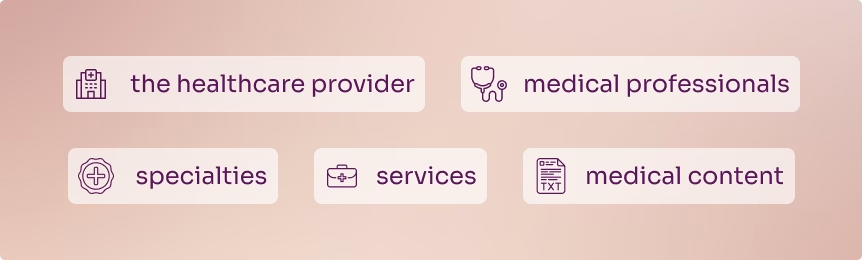
This means paying attention to:
- clear website architecture
- high-quality, up-to-date service pages
- detailed doctor profiles
- easily accessible contact details
- clear and transparent location information
- strong internal connections between content, services and specialists
- consistent information about the healthcare provider
- clear navigation
- a secure, fast and technically sound website
For example, an article about perimenopause symptoms can naturally lead users to a relevant gynaecology or endocrinology service, the profile of an appropriate specialist and information about booking an appointment.
Trust is not built through a single statement or one excellent article. It develops through a series of signals as someone moves through the website: who is behind the content, how clearly information is presented, and how easy it is to verify a service, doctor, location or way to contact the clinic.
This is also where technical SEO plays an important role. It cannot “create” expertise or authority, but it can help search engines properly discover, understand and connect the content, services and medical professionals already represented on the website.
Authority Is Built Beyond Your Own Website

It is not enough for a clinic to simply describe itself as experienced and trustworthy. Authority is also shaped by how the clinic, its doctors and its expertise are represented elsewhere online.
This is why healthcare SEO also looks at signals that come from relevant and reputable external sources.
These may include:
- high-quality backlinks from relevant medical, healthcare, business and media websites
- mentions of the clinic or its doctors in reputable media
- expert interviews and guest contributions
- doctor profiles on recognised professional platforms
- doctors or specialists being cited in articles, reports or research
- consistent and accurate information about the clinic across relevant external sources
For clinics with a physical location, local signals also matter. These include an up-to-date Google Business Profile, patient reviews, accurate contact and address details, and clear location information on the website.
A backlink from a relevant medical publication, or a doctor being cited in a professional article, can be far more valuable than ten generic links from unrelated websites. The goal is not to collect as many backlinks or brand mentions as possible. What matters more is who is referring to the clinic, how relevant that source is, and the context in which the clinic or its specialists are mentioned.
What Do YMYL and E-E-A-T Actually Change in a Healthcare SEO Strategy?
YMYL and E-E-A-T do not change the fundamentals of SEO, but they do affect how those fundamentals should be approached when working with medical and healthcare websites.
Keyword research still needs to start with search intent. Technical SEO still needs to help search engines discover, index and understand the relationship between pages. And content still needs to answer the specific question a user is trying to solve.
The difference is that, with health-related topics, much more attention needs to be paid to who is providing the answer, which sources support it, and how that content connects with the clinic’s genuine medical expertise.
This is why a strong healthcare SEO strategy usually brings together service pages, doctor and specialist profiles, educational content, local search visibility and external signals of authority.
SEO therefore becomes more than simply publishing blog articles, targeting keywords or tracking individual rankings. It is about how the website as a whole builds relevance and trust across the different stages of a patient’s search journey.
How Ginger IT Solutions Applies These Principles in Practice
On our SEO project for London Lauriston Clinic, we had the advantage of being able to plan SEO from the beginning rather than introducing it only after the website had been completed. This meant considering SEO during both the web design and development stages.
As a result, the technical foundations, structure of specialties and services, doctor profiles, accessibility and educational content were treated as connected parts of the same system rather than as separate tasks.
Once the website was live, we continued developing the SEO strategy around real questions prospective patients were searching for, while monitoring performance and improving pages that were beginning to show stronger organic potential.
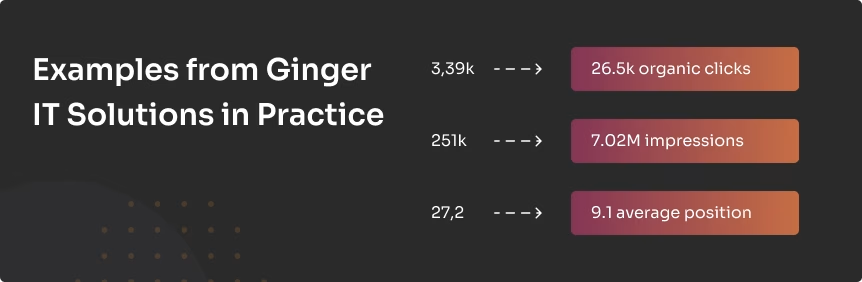
When we compared 29 March to 29 July 2025 with the same period in 2026, organic clicks increased from 3.39 thousand to 26.5 thousand, impressions rose from 251 thousand to 7.02 million, and the average position improved from 27.2 to 9.1.
It is important, however, not to draw the wrong conclusion from those results. We cannot say that “E-E-A-T increased traffic by a certain percentage”, because that would be an unsupported claim.
The growth came from the wider system: a technically sound website, clearly structured services and specialties, high-quality medical content, strong internal connections between pages, continuous optimisation and a clear presentation of the clinic’s genuine expertise.
That is perhaps the most useful way to understand E-E-A-T in practice. It is not a standalone SEO tactic, but a principle that runs through the quality of a healthcare organisation’s entire digital presence.
What Changes With AI Search?
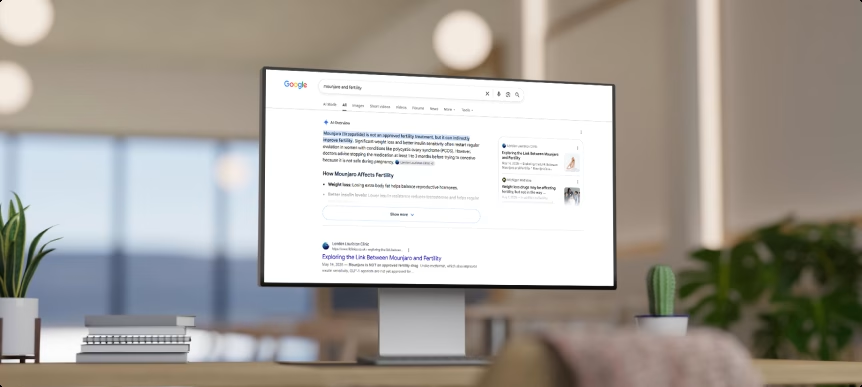
The rise of Google AI Overviews and other AI-powered search experiences makes clear, well-structured and trustworthy content even more important.
Users no longer always need to click on the first traditional search result to find an answer. AI systems can identify, summarise and combine information from multiple sources.
That does not mean there is a specific formula that can guarantee content will be “optimised for AI”. On the London Lauriston Clinic project, several medical articles appeared as sources or recommended results in Google AI Overviews, even though the content had not been created specifically for that format.
From the outset, the focus was on the fundamentals that matter for both traditional and AI search: accurate medical information, reliable sources, clear content structure, specific patient questions and strong connections between the content and the clinic’s genuine expertise.
The basic principles of good content have not changed overnight. What has changed is the way search engines can find, interpret and present that information to users.
In other words, visibility in AI-generated results should not be treated as a completely separate SEO discipline. It is another environment in which high-quality, trustworthy content can be recognised and used.
How to Tell Whether a Healthcare Website Is Really Building Trust

At Ginger IT Solutions, when we review a medical website, we do not look only at technical issues, keywords and rankings. We also assess how clearly the website demonstrates expertise, trustworthiness and transparency.
A few simple questions can quickly reveal where the weaknesses are:
- Is it clear who is behind the website and the clinic or healthcare organisation?
- Can users easily find out who the doctors are and what qualifications they have?
- Is it clear who writes the medical content and who medically reviews it?
- Are important medical claims supported by reliable and up-to-date sources?
- Is older content reviewed regularly to make sure it is still accurate?
- Are services, specialties, doctor profiles and educational content logically connected?
- Can users easily find contact details, location information and a clear next step, such as booking an appointment?
- Does the website work well technically on mobile devices?
- Does the clinic have relevant authority signals beyond its own website, such as high-quality backlinks, mentions, reviews or expert contributions?
- Is the content primarily written to answer a genuine user question, or does it appear to exist mainly to rank for a particular keyword?
If these questions do not have clear answers, the problem is unlikely to be a single meta tag or a missing keyword. More often, it lies in how the website as a whole builds and demonstrates trust.renje.
Why Good Healthcare SEO Ultimately Comes Down to Trust
YMYL and E-E-A-T should not be treated as two more SEO acronyms that simply need to be added to a strategy.
Their real value is that they bring the focus back to what must be clear to both users and search engines on a healthcare website: who is providing the information, what evidence supports it, what expertise sits behind it, and why that source should be trusted.
This is why effective healthcare SEO involves much more than optimising medical articles. It requires technical SEO, website structure, content quality, the expertise of the medical team, user experience, internal linking, external authority signals and accurate performance measurement to work together.
When these elements support one another, a healthcare website does not simply become more visible in search. It also becomes a more credible and useful source of information for people looking for answers about their health.
If you want to develop an SEO strategy that brings together technical foundations, content and the expertise of your healthcare organisation, Ginger IT Solutions works with private clinics and other healthcare organisations to build long-term organic visibility. Our approach is based on data, continuous optimisation and experience demonstrated through real healthcare SEO projects.
If your goal is not simply to increase visibility, but to help prospective patients find the right answers and take the next step with greater confidence, Ginger IT Solutions can help you build the strategy to get there.