
Category page SEO works when a product category becomes the best possible landing page for a specific commercial search intent. That requires considerably more than placing a keyword in the H1, adding a paragraph above the products and hoping Google takes the hint.
A strong category page has to help search engines understand what the page represents while helping shoppers evaluate a meaningful selection of products. That depends on how well the page aligns search intent with the way customers browse and choose products.
This distinction matters because category pages often sit at one of the most valuable points in the ecommerce journey. The shopper knows roughly what they want, but has not necessarily decided which product to buy.
Someone searching for “women’s linen dresses” or “ergonomic office chairs” is not asking for a definition. They want options. The category page should give them the right ones.
Key Insights
- Category pages suit broader commercial intent. Product pages are better suited to specific models, SKUs, variants and detailed long-tail searches.
- Category page SEO starts with search intent and ecommerce architecture, not word count.
- Not every filter combination deserves its own indexed landing page. In large catalogues, faceted navigation can generate thousands of low-value URLs.
- The product grid is part of the content. Product imagery, prices, attributes, availability and filtering options all affect how useful the page is.
- SEO decisions should influence UX and development early. Fixing category architecture after launch is possible, but usually more expensive and disruptive.
These principles sit within a much wider ecommerce SEO strategy, where category pages, product pages, technical SEO, content and conversion paths need to support the same commercial goals rather than compete for attention.
What Category Page SEO Actually Needs to Achieve
Category page SEO is the process of making a product category or collection page relevant, accessible and useful enough to serve as the search landing page for a defined group of commercial queries.
A category page has to do several things at once: explain what the product group contains, help shoppers narrow their options, and show search engines how that part of the catalogue relates to surrounding categories and products.
A product detail page, or PDP, is built around one item. A product listing page, or PLP, represents a set of products connected by a meaningful commercial relationship. That relationship might be based on product type, such as men’s running shoes; use, such as garden dining furniture; or an important attribute, such as oak dining tables.
The SEO opportunity lies in identifying which of those relationships people actually search for and which deserve permanent landing pages. Google recommends supporting this structure with a crawlable hierarchy that connects categories, subcategories and products.
A category is part of the site’s information architecture, not simply another URL that can be created because a keyword exists.
Should You Focus on Category Pages or Product Pages?
Neither category pages nor product pages should receive SEO priority by default. Search intent should determine which page type is best suited to rank.
Consider the difference:
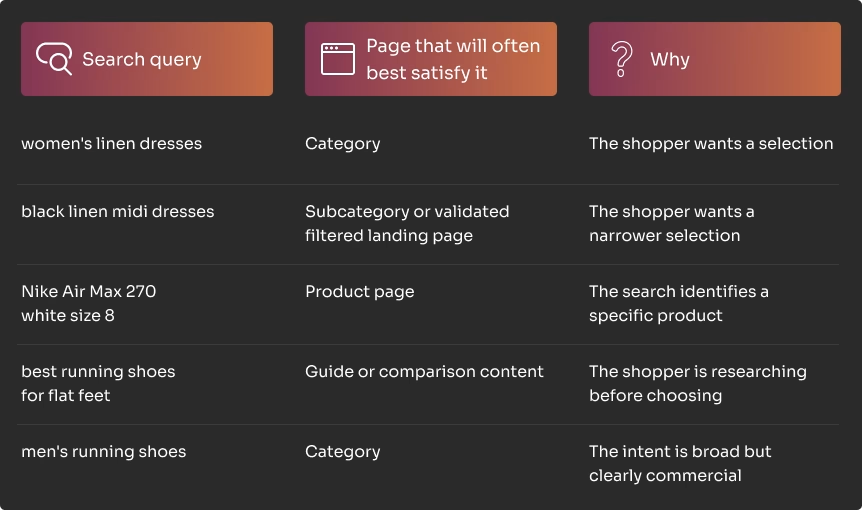
Search the main query before deciding which page should target it. If Google consistently returns category pages from relevant ecommerce sites, that is strong evidence of category-level intent. If individual products dominate, creating a category simply because the keyword has attractive search volume may achieve very little.
The same principle applies when deciding whether a separate subcategory deserves to exist.
A broad category such as “running shoes” might comfortably use filters for colour, size, brand, surface and cushioning. “Trail running shoes”, however, may warrant a permanent subcategory if it represents a distinct product range, meaningful search demand and a clearly different shopping need.
Search demand alone is not enough. The catalogue must also support the page. A category with too few relevant products, substantial overlap with another category or little independent value for shoppers is unlikely to become a strong landing page simply because a keyword exists.
Category pages capture product-group intent. Product pages capture product-specific intent. Each should be optimised for the job it is meant to perform.
Is It Impossible to Rank Ecommerce Category Pages?

Category pages rank constantly. What is difficult is getting a category page to rank when the rest of the website gives Google very little reason to regard it as important.
This commonly happens when categories are buried several clicks deep, receive weak internal linking, contain little useful context, compete with several near-identical categories, or sit beside hundreds of indexable filter combinations targeting almost the same terms.
If an individual product ranks instead, Google may simply be receiving stronger relevance and authority signals from that page than from the preferred category.
Being indexable is not the same as being important. A category can return a 200 status code, have a canonical tag, appear in the XML sitemap and still sit in relative obscurity if the site’s architecture barely acknowledges it.
Before adding another paragraph of copy, check whether the website itself behaves as though the category matters.
Category Page SEO Starts With Search Intent, Not Keyword Volume

One of the easiest ways to damage an ecommerce architecture is to turn keyword research into a URL-generation exercise.
Keyword research may reveal searches for “wooden dining tables”, “solid wood dining tables”, “oak dining tables”, “modern wooden dining tables”, and “wooden dining tables for six”. That does not automatically mean five separate categories should exist.
The first question is whether those searches represent meaningfully different shopping needs. The second is whether Google treats them as distinct search intents. The third is whether the store has enough relevant products to make each proposed landing page genuinely useful.
At Ginger IT Solutions, category planning starts by comparing search behaviour with the actual catalogue, navigation and technical setup before deciding whether another permanent URL should exist.
A keyword opportunity becomes a category only when the search intent, product range and customer journey support it.
When Does a Keyword Deserve Its Own Category?
The practical process starts by collecting commercial search terms from keyword research tools, Search Console, internal site search, competitor research and the language customers use when describing products. Those terms are then grouped by intent rather than minor variations in wording.
SERPs are reviewed to understand what Google considers an appropriate result for each search. Category pages, PDPs, editorial guides, marketplaces and mixed results can all reveal something about what the user is trying to accomplish.
Then comes the question SEO tools cannot answer on their own: Would this make a genuinely useful shopping destination?
If a proposed category contains four almost identical products and is unlikely to grow, it may be better handled as a filter. If it represents a distinct product type with its own search demand, product range and buying considerations, a dedicated landing page makes far more sense.
Baymard’s ecommerce UX research found that 75% of benchmarked sites were affected by overcategorisation. Its testing showed that separating products with shared attributes into overly narrow categories can make comparison more difficult, while filters may provide a better experience in many cases.
Creating every conceivable keyword variation as a category is not scale. Sometimes it is simply a larger collection of weak URLs.
Build Category Architecture Around How People Shop
A clean ecommerce hierarchy will often look something like:
Homepage → Category → Subcategory → Product
Google recommends connecting menus to category pages, categories to subcategories and subcategories to products through crawlable links. It also uses the relationships between pages to help understand their relative importance.
But the technically neatest taxonomy is not necessarily the most useful one. Businesses often organise products according to internal logic such as manufacturers, stock systems, technical specifications, supplier terminology or warehouse classifications.
Someone buying furniture may think by room, material, product type, style, size or intended use. Someone shopping for industrial components may think primarily in terms of compatibility or specification. Fashion shoppers may depend more heavily on fit, colour, occasion or collection.
Good category architecture translates the catalogue into the customer’s decision-making language.
From Search Intent to Category Structure
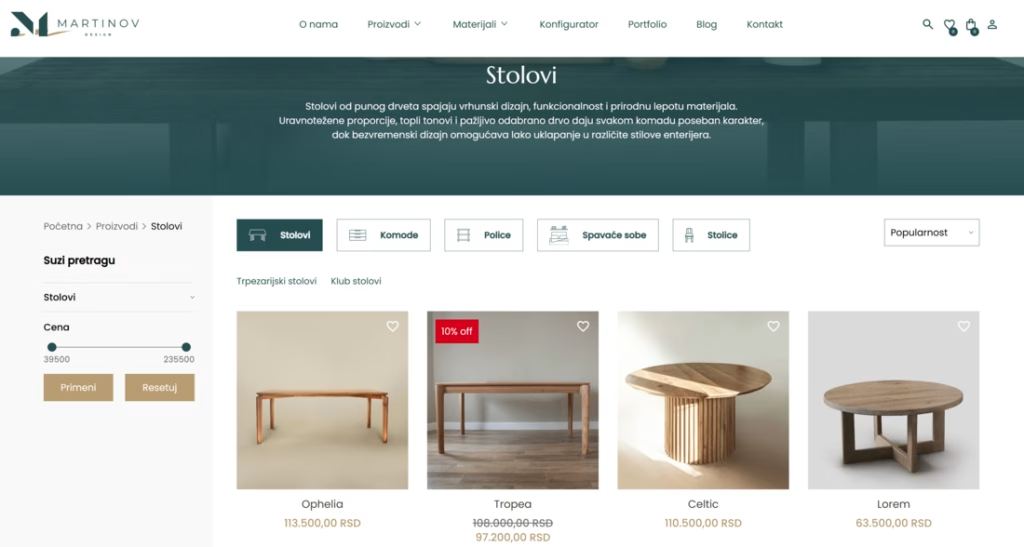
The Martinov Design project is a practical example of that approach.
Ginger IT Solutions structured tables into distinct product groups such as dining tables, coffee tables, console tables, side tables and desks because each represents a different shopping need. Material, size and style do not automatically become separate categories; those attributes can remain filters or supporting navigation unless search demand and the catalogue justify a dedicated landing page.
Before creating another category, ask whether customers recognise it as a distinct product group, whether they would reasonably browse it independently, whether search demand exists, whether search results support a separate page and whether the catalogue contains enough relevant products to keep the page useful.
This is why category architecture works best when SEO is involved early in an ecommerce project.
At Ginger IT Solutions, keyword and intent research can influence the category tree before UX/UI templates and filter logic are finalised. That allows navigation, page types and technical behaviour to be designed around the same commercial structure rather than treated as separate decisions later in the project.
What Should a High-intent Category Landing Page Contain?

A good category page should make its purpose obvious within seconds.
The H1 establishes the product group. A short introduction provides useful context. Subcategories help shoppers narrow broad selections. Filters allow them to refine products according to attributes that genuinely influence purchase decisions.
Then comes the product grid, which deserves more SEO attention than it usually gets. An ecommerce page does not consist of “content” at the top and “products” underneath. The products are part of the content.
A useful listing can communicate product names, prices, imagery, important specifications, available colours, ratings, stock status, variations or other category-specific attributes before someone opens a PDP.
Baymard found that 50% of benchmarked ecommerce sites failed to show enough useful information in product listings, making it harder for users to evaluate products without repeatedly opening individual product pages. That is both a UX issue and a commercial one.
Take an office chair category. If lumbar adjustment is a major buying consideration, making users open 15 PDPs to discover which chairs offer it is poor product-list design.
The relevant attributes change by category: screen size and memory for laptops, dimensions and materials for furniture, or available colours and sizes for clothing.
Good category-page design should therefore ask: What information does someone need before deciding which products deserve a closer look?
Breadcrumbs, related categories and clearly designed subcategories should also help users understand where they are and where they can go next.
Product imagery plays an important role here as well. A category with inconsistent ratios, weak thumbnails or visually indistinguishable products creates unnecessary work for shoppers.
The role of product visuals in online stores extends beyond aesthetics. Images help people identify, compare and shortlist products before they reach the product page.
How Much Copy Does Category Page SEO Really Need?
A category needs enough written content to establish relevance and help shoppers make decisions.
A concise introduction above the product listing can explain what the category contains, clarify meaningful distinctions and naturally use the language customers search with. More detailed guidance can sit lower on the page where it supports the buying decision.
Comparisons, selection advice, delivery information and other useful modules often add more value than generic filler. Depending on the category, this may include guidance on materials, compatibility, sizing, applications, care, product differences or common purchasing questions.
The format should follow what shoppers need to know before choosing. A technical equipment category may warrant detailed compatibility guidance, while a luxury fashion category may need very little explanatory copy.
This is why blindly copying competitors’ word counts makes little sense. Their catalogue, authority, brand, UX, audience and ranking signals are not yours.
And nobody needs another paragraph beginning: “Discover our fantastic range of high-quality products designed to suit every style and need…”
Useful copy should answer a real question or help someone choose. A simple rule is to write only as much as the buying decision requires.
Category Page SEO Gets Complicated When Filters Create URLs

Filters are valuable for shoppers, but they can create serious SEO complications.
Imagine a footwear category filtered by gender, size, colour, brand, material, width, price, activity and availability. Each option helps the user, but every combination can also generate another URL.
Google warns that faceted navigation can create a “near-infinite number of URLs”, leading to unnecessary crawling and potentially slowing the discovery of more important pages. This turns a simple UX feature into an architectural SEO decision.
Filter combinations generally fall into three groups:
- filters that exist purely for usability and do not need SEO visibility
- URLs that may exist for technical reasons but should not become indexable landing pages
- a smaller number of combinations that deserve indexation because they represent clear search demand and a genuinely useful product selection
For example, “women’s waterproof hiking boots” may justify its own landing page if the search intent, catalogue and demand support it. “Women’s waterproof blue hiking boots size 5 under $150” probably does not.
There is no universal setup for faceted navigation, the system that creates product selections through multiple filters. Canonicals, crawl directives, URL parameters, internal linking, pagination and JavaScript behaviour all need to work together.
Google also notes that crawlers primarily discover pages through links using <a href>, rather than by interacting with filters, buttons or JavaScript like a user would. Pagination and “load more” functionality therefore still need to provide crawlable access to products.
For larger catalogues, this quickly becomes a technical SEO issue involving crawlability, indexing, pagination, structured data and site performance.
Internal Linking Tells Google Which Categories Matter

Internal linking helps search engines understand how ecommerce pages relate to one another and which pages carry greater importance within the site.
Main navigation can support top-level categories. Parent categories can link to important subcategories. Products can link back to their relevant category where useful. Breadcrumbs reinforce hierarchy, while related-category modules create logical lateral connections.
Editorial content can strengthen the same structure by connecting informational searches with the appropriate commercial destination.
For the Martinov Design website, Ginger IT Solutions connected the guide on how to choose a dining table with the relevant dining tables category. The guide answers research-stage questions about choosing the right table, while the category gives readers a direct path to relevant products.
This creates a logical informational-to-commercial journey instead of treating blog content and category pages as separate SEO assets.
The same principle works in reverse: category pages can link to useful guides when shoppers need more information before choosing.
Internal linking should therefore follow genuine relationships between topics, products and buying decisions rather than a fixed rule about how many internal links each page needs.
Category Page SEO Also Depends on Merchandising
SEO teams sometimes discuss category pages as though all products inside them were interchangeable blue links.
Customers do not experience them that way. They see an assortment.
Which products appear first matters. Which are in stock matters. Which have compelling imagery matters. Whether the first row contains four near-identical products matters.
Category page SEO therefore overlaps with ecommerce merchandising.
If search demand around a category changes seasonally, the product selection and supporting content may need to change with it. If the strongest products are buried under irrelevant default sorting, the page may technically rank while commercially underperforming. If half the products are unavailable, the search landing experience deteriorates even though the title tag remains beautifully optimised.
Category pages should be maintained as the catalogue, availability and customer demand change. That may mean updating product selections, supporting content or category structure when the current page no longer reflects what the business sells or what shoppers are looking for.
The goal is not artificial freshness, but keeping the page commercially accurate and useful.
Category Page SEO is Also a UX Problem

A page can rank well and still be a poor landing page.
Ranking gets the user onto the page. UX determines whether the page helps them continue.
This is where SEO, design and merchandising can pull in different directions. An SEO specialist may want additional explanatory content. A designer may want a cleaner visual hierarchy. A merchandiser wants products visible immediately.
The best solution usually balances all three.
Category pages need enough context to support search visibility without allowing informational copy to interfere with their main purpose: helping users browse, compare and choose products.
Good ecommerce design resolves that tension through hierarchy. Important commercial information appears where shoppers need it, while supporting content sits where it can answer questions without pushing the catalogue too far down the page.
When Category Page SEO Becomes an E-commerce Development Issue
There is a point where optimisation cannot be completed inside an SEO tool or CMS editor.
Changing a title tag is simple. Changing how filtered URLs are generated, exposing additional product attributes, building crawlable pagination, adjusting JavaScript rendering or restructuring taxonomy usually requires development work.
At that stage, businesses often need to partner with e-commerce development experts who can translate SEO and UX requirements into a reliable ecommerce system.
At Ginger IT Solutions, category architecture, UX/UI requirements and technical SEO are considered before key development decisions are locked in. That means category templates, filter behaviour, crawlable navigation, product data and supporting content modules can be planned around the same commercial structure rather than corrected individually after launch.
SEO can then validate whether search engines are discovering and understanding the pages the business actually wants to grow.
The value lies in those disciplines working together.
An SEO specialist should not discover after launch that every filter creates an indexable URL. A developer should not have to reverse-engineer the purpose of 200 categories from a keyword spreadsheet. A designer should not find out at the end that a category template needs room for subcategories, comparison content and supporting modules.
The main principle is simple: SEO architecture should be considered during ecommerce planning and development, not added as a corrective layer after the store is already built.
How to Audit Category Page SEO in Practice

A category-page audit should start with business value, not with checking every URL equally. Prioritise categories with strong revenue potential, meaningful non-branded demand or existing organic visibility.
Then check five things:
- Search intent: Is the right page ranking for the target query?
- Site structure: Is the category easy to reach and well supported by internal links?
- Page purpose: Does it deserve to exist as a separate landing page, or does it overlap with another category or filter?
- Shopping experience: Are the products, filters, imagery and product information useful enough to support a decision?
- Technical setup: Are indexability, canonicals, pagination, filtered URLs and crawl paths working as intended?
The order matters. There is little value in rewriting category copy if the wrong page is ranking or the preferred URL is being canonicalised elsewhere.
Category pages should ultimately be measured as commercial landing pages, connecting organic visibility with product engagement, conversions and revenue rather than rankings alone.
Build Category Pages Around Decisions, Not Keywords
Strong category page SEO begins with one question: What product selection does this customer expect to find after making this search?
The answer should influence the URL, taxonomy, product assortment, filters, supporting content, internal links, UX and technical implementation.
Category pages and product pages therefore do not need to compete for SEO priority. They need clearly defined roles based on the intent they are designed to serve.
For ecommerce businesses planning a new store or redesigning an existing website, those decisions are easier to get right before development becomes difficult to change. At Ginger IT Solutions, category architecture is planned alongside UX/UI, SEO and ecommerce development so search behaviour and shopping behaviour shape the same store structure.
That is ultimately what a category page should do: bring the right shopper into the right part of the catalogue and make the next decision easier.