SEO for private clinics does not begin with publishing blog posts, and it certainly does not end with achieving a few strong Google rankings.
Is SEO in the healthcare industry more demanding than in many other sectors? Yes, but not because Google has a special algorithm for healthcare websites that needs to be satisfied before a site is “rewarded” with higher rankings and more clicks.
The reason is simple: when the subject is health, inaccurate, outdated or poorly presented information can directly influence the decisions people make about their health. This is why Google applies a much higher standard to medical content when it comes to trust, expertise, accuracy and reliability.
However, high-quality medical content is not the only factor that determines SEO success in this industry. Results depend just as much on how well the website’s technical foundations, structure, user experience and accessibility work together, as well as on how clearly the clinic’s expertise is communicated to both users and search engines.
This is exactly what we saw with the London Lauriston Clinic project, a private clinic in London for which Ginger IT Solutions first planned and developed a new website, before taking on its ongoing SEO strategy from March 2025 onwards.
This project is particularly interesting for another reason: SEO was not introduced as a corrective measure after the website had already been completed. The technical foundations, content structure and user experience could all be planned from the outset, and then gradually refined through ongoing SEO work based on real data about what users search for and how they interact with the site.
What Do the Results Show After More Than a Year of SEO Work?
To assess how organic visibility changed over the course of the project, we compared the same period across two consecutive years: 29 March to 29 July 2025 and 29 March to 29 July 2026.
Comparing the same part of the year gave us a clearer view of the changes, as it reduced the impact of seasonal fluctuations and allowed us to evaluate performance across comparable timeframes.
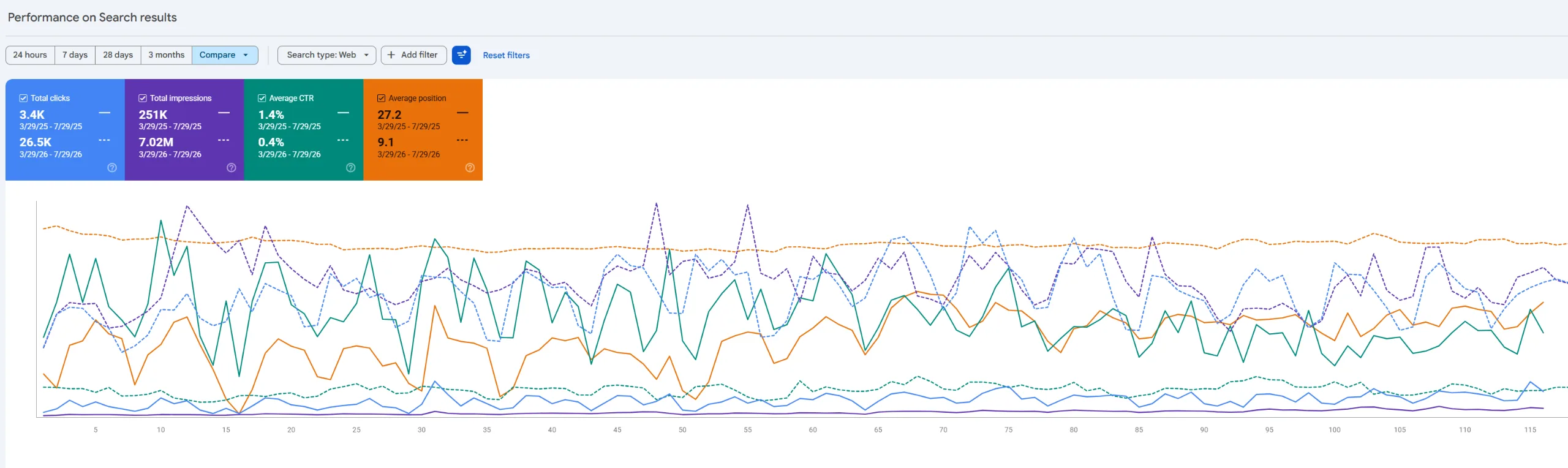
The results show strong growth across almost all key organic metrics:
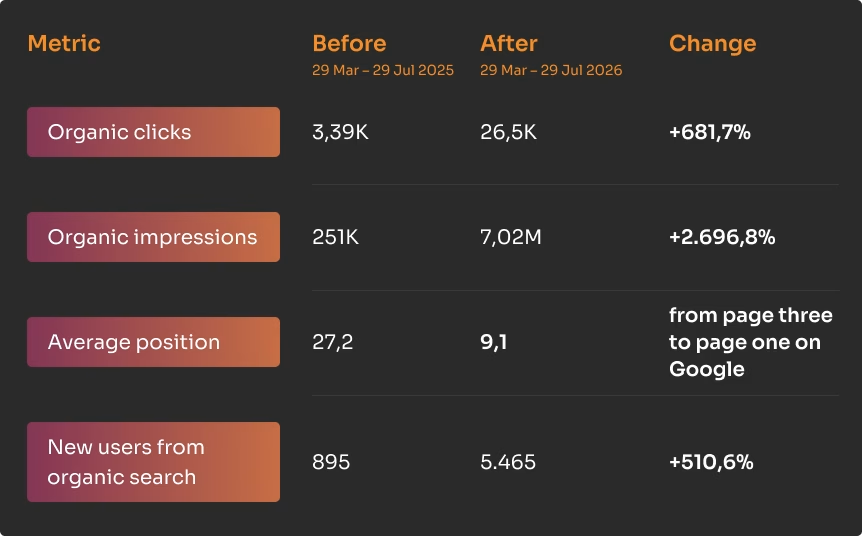
For us, however, the most valuable part of the project is not simply the high percentage increases. Even more important are the patterns behind them, because they show what actually contributed to that organic growth.
A closer look at the data reveals:
- which types of content attracted prospective patients
- why it was important to plan technical SEO during the website development process
- how user behaviour changed over time
- why certain medical content also began appearing in Google AI Overviews
Project lesson #1
The significant organic growth did not come from a single breakthrough, one SEO tactic or one successful article. It was the result of a technically strong website, a planned approach to content development and continuous improvement guided by real data.
Why Was This SEO Project for a Private Clinic Different?

Many SEO projects begin only after a website has already been completed. Structural issues, indexation problems and pages that were not planned around the way users actually search for services then have to be corrected later.
With the London Lauriston Clinic project, SEO could be considered from the very beginning, during both the web design and website development stages. This allowed the structure of medical specialties, services, doctor profiles and educational content to be planned in a way that supported both users and future organic growth.
For a private clinic covering several medical specialties, this is particularly important. If the relationships between services, specialties and content are not clearly defined, the issue goes beyond user experience. It also becomes harder for Google to understand which pages represent the clinic’s core services, how different topics relate to one another and which page is most relevant for a particular search query.
A strong technical foundation does not guarantee organic growth on its own, but it removes many of the obstacles that can limit it later.
In this case, that included:
- a logical site architecture and consistent URL structure
- correct indexation and canonical tags
- clear navigation and a strong foundation for internal linking
- good website performance and mobile experience
- breadcrumbs and structured data where relevant
- a structure that allows new content to be added without creating duplicate or competing topics
When this kind of foundation is put in place early, new content does not become a collection of isolated pages. Instead, each new page becomes part of a broader and more coherent topical structure across the website.
Accessibility Was Part of the Project From the Very Beginning
Another important decision was made before the website was even launched: accessibility was treated as an integral part of the design and development process from the outset.
For a healthcare provider, this is particularly important. Information about doctors, appointments, treatments and how to contact the clinic should be accessible to as wide a range of users as possible, including people with visual, motor and other impairments.
For this reason, the London Lauriston Clinic website was developed, as far as possible within the scope of the project, in line with the WCAG 2.1 AA web accessibility guidelines.
This influenced a range of decisions that users may not consciously notice: the contrast between text and background, typography size and readability, heading structure, keyboard navigation, clear labelling of interactive elements and a logical content order.
However, one point is important to emphasise:
Accessibility is not a direct SEO ranking factor, and it would not be accurate to claim that accessibility itself was responsible for the growth in organic traffic on this project. However, accessibility, good user experience and effective SEO are built on many of the same principles, particularly clear structure, understandable content, logical navigation and technically sound website development.
Interestingly, the London Lauriston Clinic website, which was developed with accessibility requirements more consistently in mind than any other project in the Ginger IT Solutions portfolio, later became one of the agency’s most successful SEO projects.
Project Lesson #2
When site structure, technical foundations, user experience and accessibility are considered during the design and development stages, subsequent SEO work has a much stronger foundation for growth. London Lauriston Clinic is a good example of why web development, UX, accessibility and SEO are best viewed as interconnected parts of the same project.
Why Is SEO for Healthcare Clinics More Demanding Than in Most Other Industries?

Medical content, and health information more broadly, can directly influence the decisions people make about appointments, treatment and care. This is why health-related topics fall within Google’s YMYL (Your Money or Your Life) category, which covers subjects where inaccurate or unreliable information could have serious consequences for users.
This is one of the reasons why healthcare SEO requires a higher level of attention to trust, expertise and content quality than SEO in many other industries.
The quality of a medical page cannot be assessed solely through keyword use or technical optimisation. It should also clearly demonstrate:
- who is responsible for the content
- whether the information is medically accurate and supported by reliable sources
- who wrote the content or who medically reviewed it
- what qualifications and experience the doctors and consultants have
- whether information about the clinic and its services is clear and verifiable
- whether medical content is reviewed and updated regularly
- whether users can easily find contact details and understand what to do next
- whether the clinic and its specialists have credibility beyond their own website
This is why SEO for healthcare clinics quickly becomes a question of the authority and trustworthiness of the entire website, rather than simply the optimisation of individual pages.
These elements are closely linked to Google’s E-E-A-T principles: Experience, Expertise, Authoritativeness and Trustworthiness.
E-E-A-T is not something that can simply be added to a website’s code. Trust has to be built across the clinic’s entire online presence: through detailed professional profiles, accurate and up-to-date information, reliable sources, a clear website structure, transparent contact details and content that explains medical topics without exaggerated claims or unnecessary complexity.
Project Lesson #3
For healthcare websites, publishing medically accurate content is not enough. The website also needs to make it clear why users can trust both the information itself and the organisation publishing it.
What Had the Greatest Impact on the Private Clinic’s SEO Growth?
The overall results show how much the clinic’s organic visibility increased, but for us, the more interesting question was where that growth actually came from.
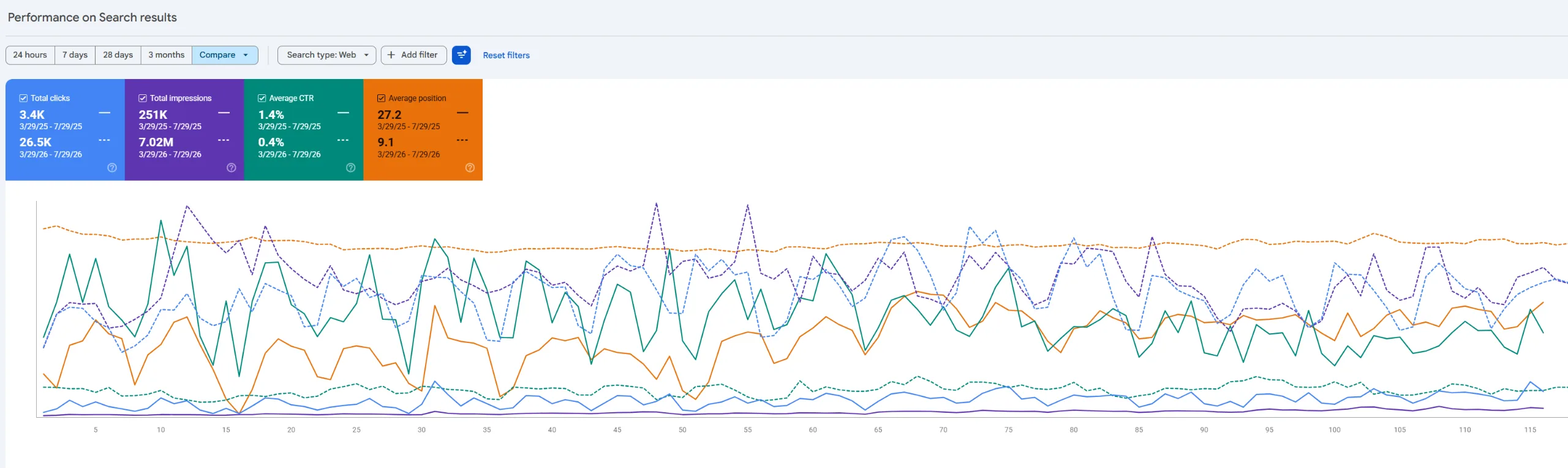
Google Search Console shows an increase in organic clicks from 3.39 thousand to 26.5 thousand and in impressions from 251 thousand to 7.02 million, while the average position improved from 27.2 to 9.1.
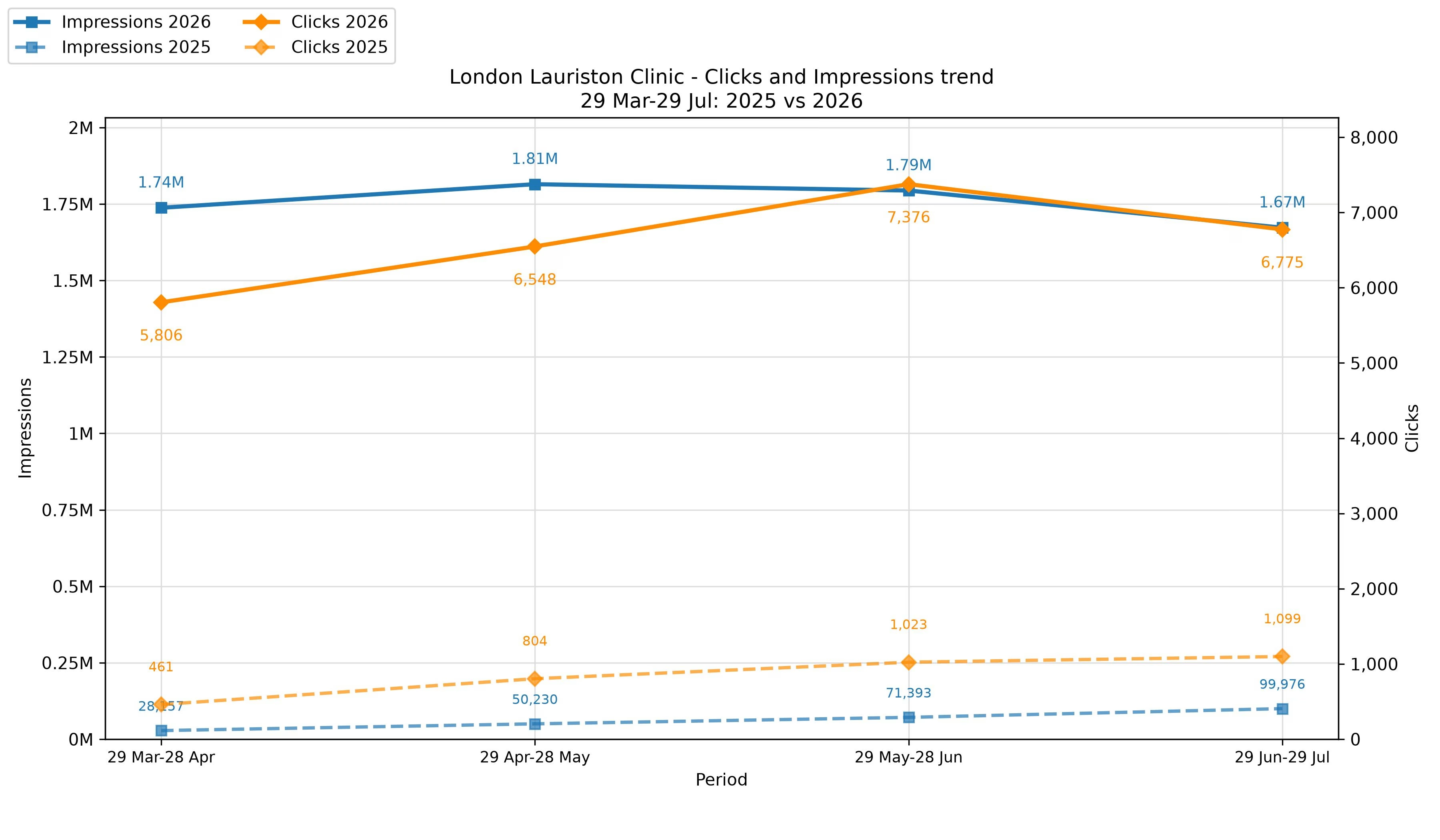
The growth is also clear when comparing the same periods in 2025 and 2026. From the end of March to the end of July 2026, the website generated several times more impressions and clicks in every period analysed than it had a year earlier. Between 29 June and 29 July, for example, impressions increased from approximately 100 thousand to 1.67 million, while clicks rose from 1,099 to 6,775.
When the data is analysed at individual page level, it becomes clear that the growth was not concentrated around the homepage or a single successful topic. Among the pages generating the highest number of organic clicks were content covering iron levels and when an iron infusion may be needed, symptoms of iron deficiency, the benefits and risks of iron infusions, endocrine tests, the relationship between Mounjaro and fertility, and perimenopause and menopause.
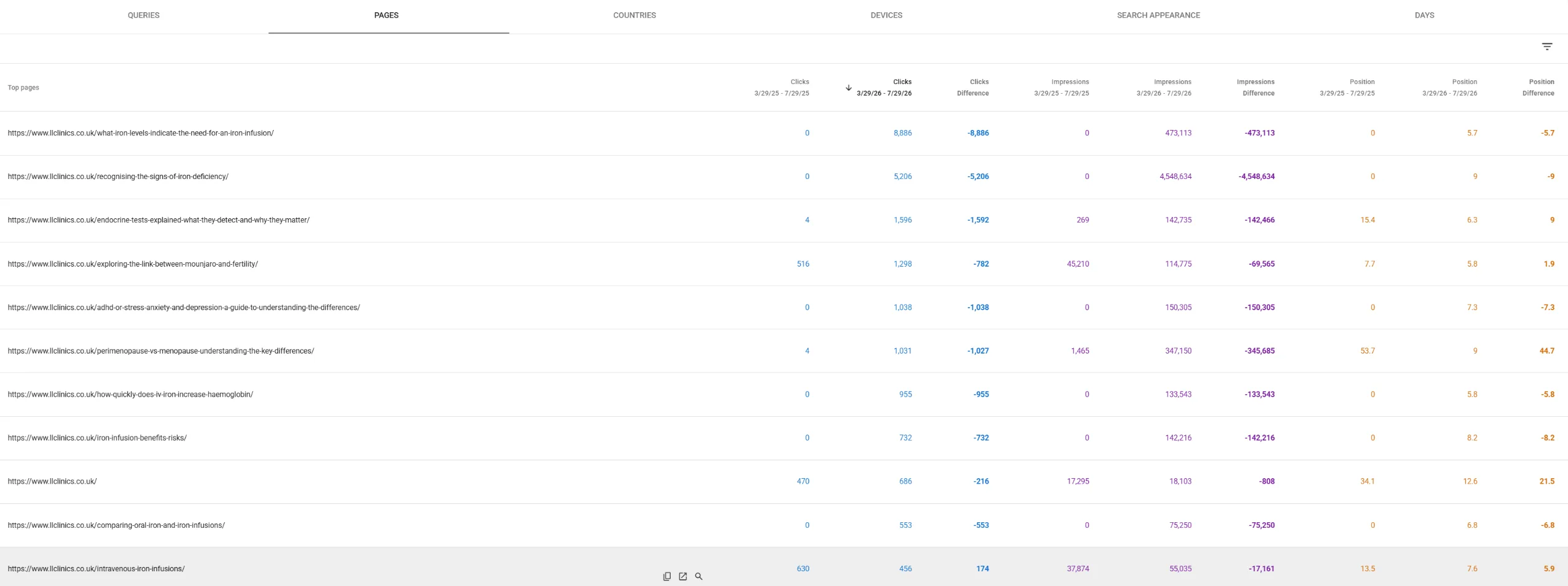
Two distinct sources of growth can be identified. Some pages that already had organic visibility continued to improve. For example, the article exploring the relationship between Mounjaro and fertility increased from 516 to 1,298 organic clicks, while its average position improved from 7.7 to 5.8.
At the same time, a significant share of the growth came from new blog content that had not yet been published during the comparable period in 2025. The article covering iron levels and indications for iron infusion generated 8,886 clicks and more than 473,000 impressions, while the article on iron deficiency symptoms generated 5,206 clicks and more than 454,000 impressions during the analysed period in 2026.
In other words, the results were not driven by one article. They were driven by a system. A content system that gradually expanded the clinic’s organic visibility across multiple medical topics connected to its services and expertise, all within a clearly defined content marketing strategy.
This wider organic reach can also be seen in another metric that needs to be interpreted in context. Average CTR decreased from 1.4% to 0.4%. Viewed in isolation, that decline could appear negative. However, when we consider that impressions increased by almost 28 times, alongside strong growth in clicks and a substantial improvement in average position, the picture looks very different.
The website is now appearing for a much broader range of relevant searches than before. Some of those new impressions come from queries where the pages are not yet ranking among the top results, and lower positions naturally generate a lower percentage of clicks. For that reason, the decline in average CTR should not be assessed in isolation, but alongside the significant growth in impressions and clicks and the improvement in average position.
Project Lesson #4
The strongest organic growth did not come from one popular topic. It came from a content system designed to answer a wide range of specific patient questions and connect them with areas where the clinic has genuine expertise and provides relevant services.
How Do You Choose Topics That Actually Attract Prospective Patients?

One of the most common mistakes in healthcare SEO is choosing topics primarily on the basis of monthly search volume.
Search volume is a useful indicator, but for a private clinic, it does not tell you enough about the real value of a topic. It is far more important to understand why someone is searching, how closely their question relates to the clinic’s services, and what their likely next step might be.
When prioritising topics as part of a content plan, preference should therefore be given to those that meet three criteria:
- they answer a specific question or concern a prospective patient may have
- they are directly related to a specialty, diagnostic service or treatment offered by the clinic
- they create a natural path towards further research through related content, an appointment, consultation or treatment
This does not mean broader educational topics should be avoided. On the contrary, they can be highly valuable for building authority and covering a wider medical subject area.
However, when resources are limited, priority should be given to content that combines clear search intent with a logical connection to the clinic’s services. A highly specific query with lower search volume can sometimes have greater commercial value than a broad topic with thousands of searches, particularly when it comes from someone who is already actively researching symptoms, diagnostic options or treatment.
Data from the London Lauriston Clinic project supports this approach. Some of the strongest visibility came from highly specific questions about symptoms, tests and treatments, in other words, content that fits naturally into the patient journey from initial research through to seeking professional medical advice.
Project Lesson #5
The most valuable topic is not necessarily the one with the highest search volume. For a private clinic, content that answers a specific patient question and naturally connects that person with the professional care the clinic can provide will often have greater value.
Why Were Educational Articles Important for Organic Growth?

Google Analytics data shows that educational articles were among the most visited organic landing pages on the London Lauriston Clinic website. This means that a user’s first interaction with the clinic was often not the homepage or a specific service page, but a piece of content answering a particular question a prospective patient was already asking.
There is a simple reason for this: at an early stage of their research, patients often do not yet know which service they need. They may only know the symptom they are experiencing, the result of a test, or the question that is concerning them.
This is where educational content plays an important role. If an article provides a clear, accurate and genuinely useful answer, it creates a positive first impression of the clinic’s expertise. When that content is then logically connected to a relevant service or specialist, moving to the next step feels natural.
Medical content, however, requires an additional level of care and caution.
An SEO specialist cannot make a medical claim sound stronger or more certain than the available medical evidence supports simply because a more dramatic headline might attract more clicks. Treatment outcomes should not be promised, correlation should not be presented as causation, and information about medication, pregnancy, diagnosis or treatment should not be simplified to the point where medical accuracy is lost.
For that reason, high-quality healthcare content is often the result of collaboration between an SEO specialist, copywriter and medical professional, rather than SEO copywriting alone.
Strong internal linking can then help users continue their research naturally. For example, an article about iron deficiency might lead to:
- an explanation of laboratory test results
- an article about when an iron infusion may be considered
- the iron infusion service page
- a consultation with the appropriate specialist
Internal links in this context do more than support SEO. They help users find the next relevant piece of information without having to return to Google, while also following the natural sequence of questions that often arises when someone is researching a health concern.
The same pattern can be seen in the London Lauriston Clinic data presented below.
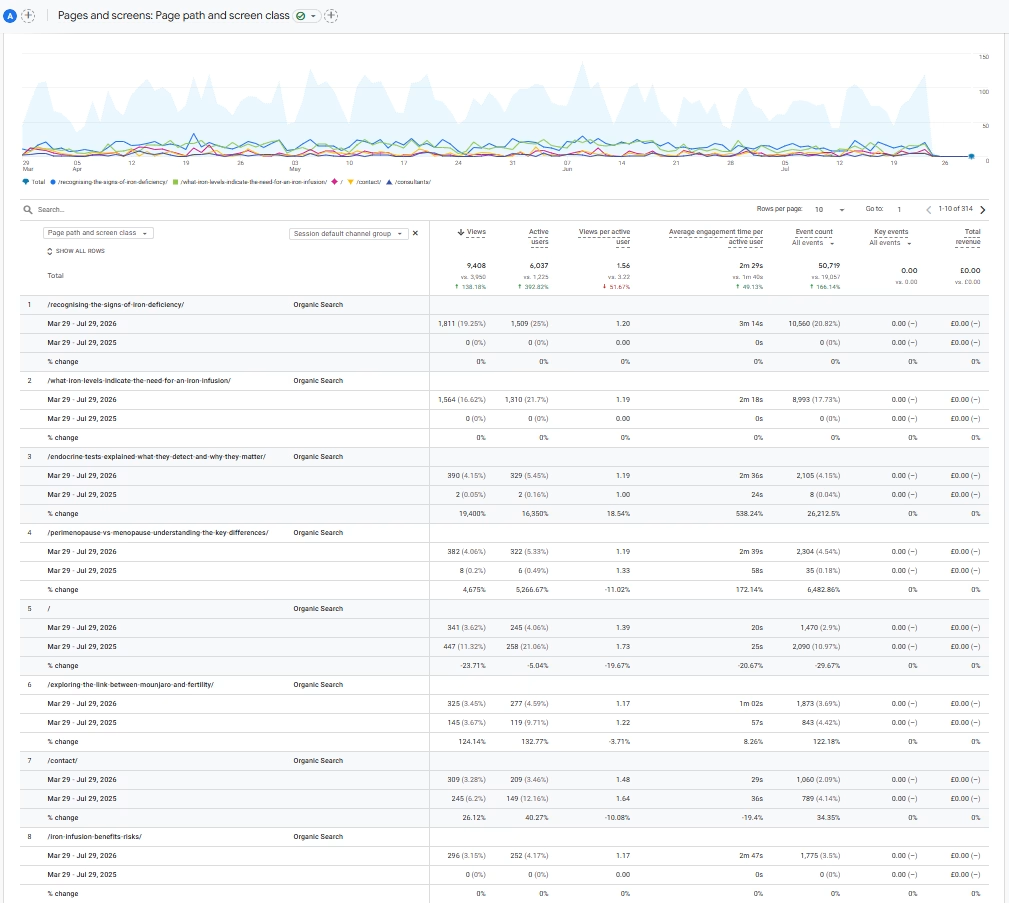
Educational articles covering iron deficiency, endocrine tests, menopause and other medical topics not only attracted organic traffic, but also recorded substantial user engagement. For example, the article on signs of iron deficiency had an average engagement time of approximately 3 minutes and 14 seconds, while the article on iron levels and iron infusions recorded around 2 minutes and 18 seconds.
This suggests that users were not simply landing on these pages and leaving immediately. They were spending meaningful time engaging with the content.
Project Lesson #6
Educational content delivers the greatest value when it does not try to “sell” a service immediately, but first answers the patient’s question, builds trust and then provides a clear path towards the next relevant piece of information, service or specialist.
Was the Organic Traffic Generated Through This SEO Project High Quality?

Google Search Console shows how much the London Lauriston Clinic website increased its visibility in Google Search, but it does not tell us enough about what happened after users clicked through. To assess the quality of organic traffic, it is therefore important to look at Google Analytics data as well.
Across the two comparison periods, the number of new users arriving through organic search increased from 895 to 5,465, while the total number of users from this channel rose from 913 to 5,521.
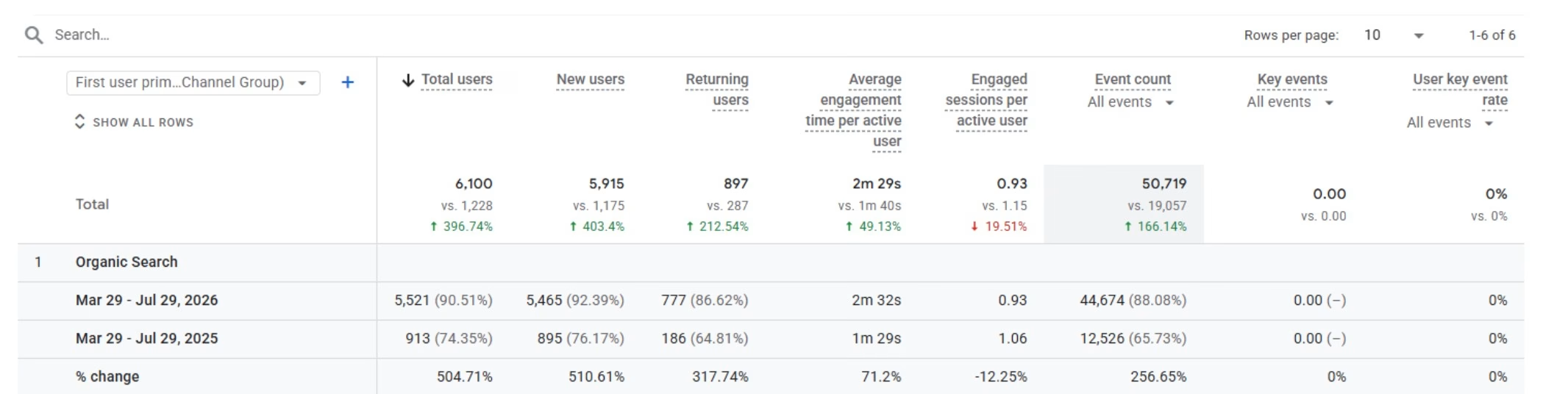
More importantly, the growth was not limited to user numbers. Organic sessions increased from 1,500 to 6,667, representing growth of 344.5%, while engaged sessions rose from 1,095 to 5,133, an increase of almost 369%.
At the same time, average engagement time per organic session increased from 1 minute and 2 seconds to 2 minutes and 6 seconds. The engagement rate also rose from 73% to almost 77%.
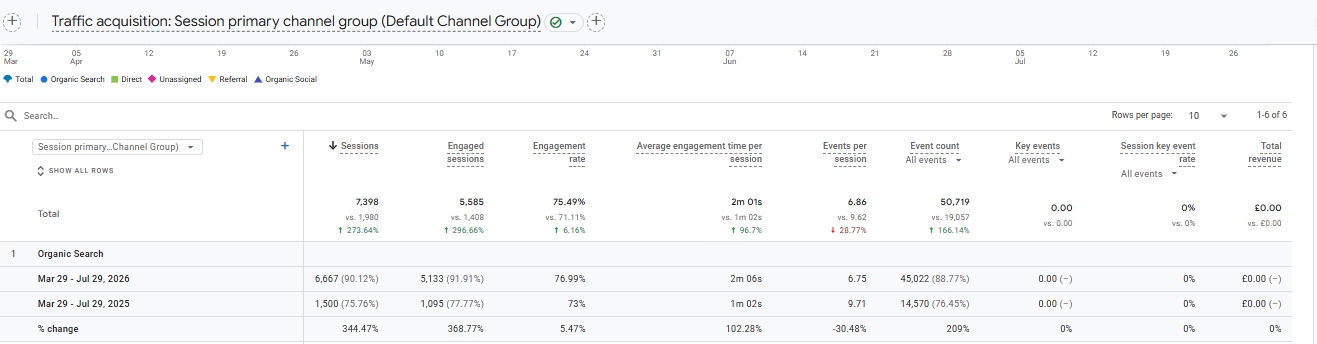
These figures provide important context for the results:
Organic search did not simply bring significantly more visits to the website. That growth was accompanied by a higher engagement rate and more than double the average engagement time per session.
For medical topics, longer engagement is particularly meaningful. Users often need more time to read an explanation of symptoms, understand test results, or learn about a particular examination or treatment.
Longer engagement does not, on its own, prove that the content resulted in an appointment booking. However, it does show that the increase in organic traffic was not accompanied by a decline in the quality of users’ interaction with the website.
The relationship with other traffic channels is also noteworthy. During the analysed period in 2026, 90.12% of all recorded sessions came from organic search, compared with 75.76% a year earlier. Organic search therefore became an even more dominant source of website traffic.
There is, however, a limit to what the available data can confirm. In the current Google Analytics setup, key events have not been defined in a way that would allow us to reliably connect organic traffic with a specific enquiry or a completed appointment booking.
Project Lesson #7
Organic traffic growth becomes more valuable when it is accompanied by stronger user engagement. In this case, the increase in organic users was matched by more engaged sessions and longer average engagement time, providing a much more complete picture of performance than traffic figures alone.
Why Is the Quality of Medical Content More Important Than Quantity?

Publishing a large volume of articles can quickly fill a blog, but in healthcare, quantity alone does not build authority. What matters far more is that the content is accurate, useful and clear enough for patients to understand without oversimplifying the subject.
For healthcare SEO to deliver sustainable results, medical content should therefore be:
- based on relevant and up-to-date sources
- sufficiently detailed to preserve medical accuracy
- written in clear, accessible language for patients
- connected to the clinic’s services and medical team
- reviewed and updated regularly
For topics involving diagnosis, treatment or medication, reliable sources such as the NHS, NICE guidelines, Cochrane reviews and relevant peer-reviewed research are particularly important. The aim is not to make an article read like an academic paper, but to translate specialist information into language patients can understand easily, without losing accuracy or important medical context.
This is one of the biggest challenges in creating healthcare content, and something the Ginger IT team paid particular attention to throughout this project. Content that is too technical can distance the reader, while content that is oversimplified can lose both precision and credibility. Good medical content needs to strike a careful balance between the two.
Project Lesson #8
The quality of medical content is not determined by how many technical terms it contains, but by its ability to provide an accurate, verifiable and understandable answer while maintaining a clear distinction between general information and individual medical advice.
How Does a Patient’s Search Change From Symptoms to a Specific Service?
For the London Lauriston Clinic project, keyword research was not simply about identifying the phrases individual pages should rank for. It was also important to understand how a patient’s search behaviour changes from their first question about a health concern to looking for a specific service or specialist.
For example, the path towards searching for an iron infusion in London might look like this:
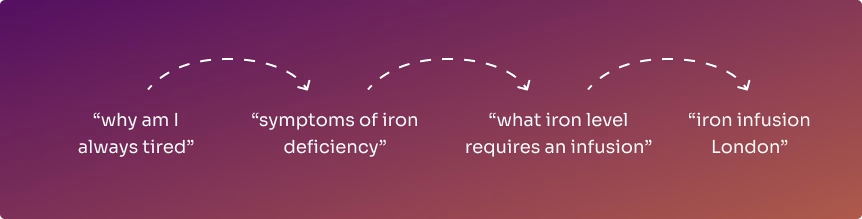
Each of these queries relates to the same broader health need, but represents a different stage of the research process.
If the SEO strategy focused only on the final query, the clinic would be trying to reach a prospective patient only when they were already close to making a decision. By covering the relevant questions that come before that stage, the clinic can become visible much earlier in the research journey.
This is why educational content that precedes a direct search for a specific service played such an important role in this project. These topics were not selected solely for their organic traffic potential, but because they answered questions that naturally arise before someone decides to book an appointment, consider treatment or speak to a doctor.
When this content is connected through internal links and leads naturally towards relevant service pages, the SEO strategy can support users through the different stages they move through while trying to understand their health concerns and decide what to do next.
Project Lesson #9
Effective keyword research for a healthcare clinic does not end with identifying the phrase that leads directly to a service. It also requires understanding the questions that come before it and how a patient’s search behaviour changes from initial research through to seeking professional medical advice.
Who Are the Real SEO Competitors of a Private Clinic?

For the London Lauriston Clinic project, competition in organic search did not come only from other private clinics in London. For many medical queries, the highest-ranking results include content from authoritative domains such as the NHS, NICE, Mayo Clinic, Cleveland Clinic, Johns Hopkins, as well as university hospitals, major healthcare publishers and scientific publications.
This means that, for certain queries, a private clinic is competing for visibility with some of the most authoritative medical sources in the world. This is one of the factors that makes healthcare SEO particularly competitive.
In that kind of competitive environment, there is little value in trying to rank for every broad or generic health topic. For a private healthcare provider such as London Lauriston Clinic, it is more sensible to focus on more specific questions that are closely related to its services and where the clinic can provide an expert, useful and sufficiently detailed answer.
This was an important part of the approach taken throughout the project. Topic selection was based not only on monthly search volume or keyword difficulty, but also on where the clinic could genuinely offer relevant content grounded in its own expertise and the needs of prospective patients.
This allows organic visibility to grow in areas that also make commercial sense, rather than using resources to compete for broad topics where ranking against major medical authorities is considerably more difficult.
Project Lesson #10
In healthcare SEO, the goal is not to rank for every major medical topic. It is more valuable to identify specific questions where the clinic can provide an expert, clear and genuinely relevant answer.
What Does Google AI Overview Visibility Tell Us About the Clinic’s Content?
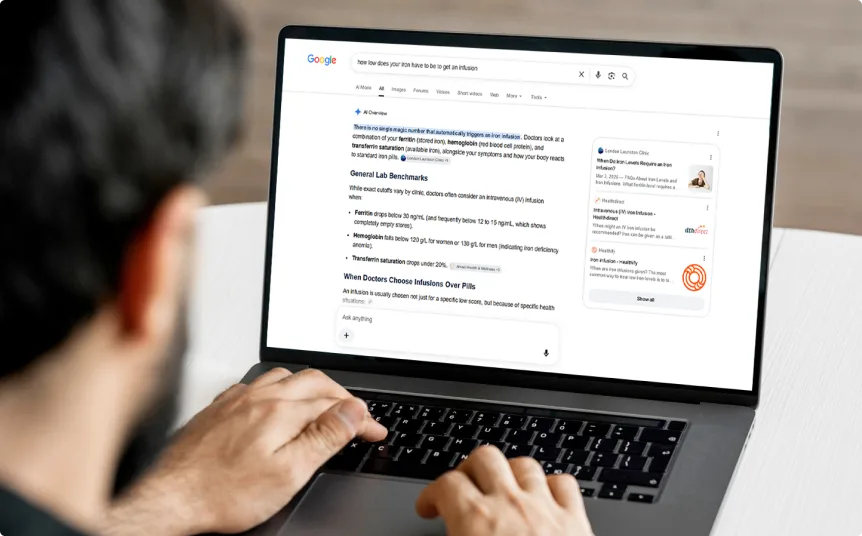
The way people access health information is changing. Alongside traditional search results, Google AI Overviews can provide a summarised answer directly within the search results and show the sources used to support that response.
This means that a clinic is no longer competing only for rankings and clicks, but also for the opportunity to have its content recognised as a source that AI systems use or cite.
The London Lauriston Clinic project provides a practical example of this. Several of the clinic’s articles appeared as sources or recommended results in AI Overviews for medical queries relating to iron levels and indications for iron infusion, the relationship between Mounjaro and fertility, and endocrine testing.
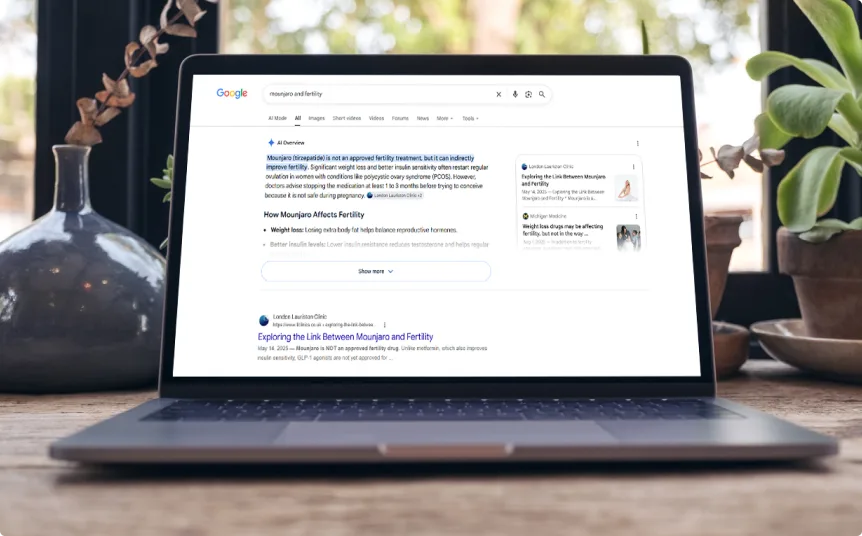
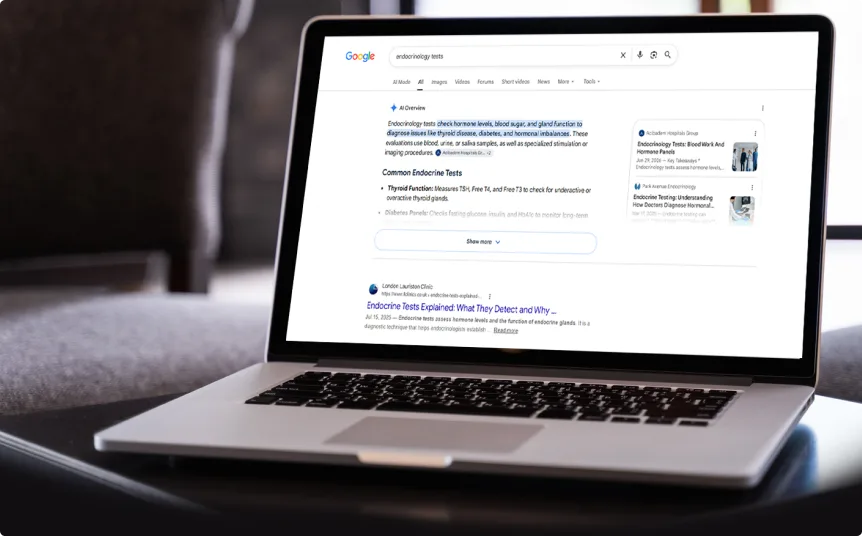
However, these examples do not suggest that there is a specific SEO technique that can guarantee visibility in AI Overviews. The London Lauriston Clinic strategy was not designed around the idea of specifically “optimising for AI”.
From the outset, the Ginger IT SEO team focused on:
- answering clearly defined user questions
- maintaining medical accuracy and using reliable sources
- creating clear and logical content structures
- ensuring a technically sound website
- connecting topics with the clinic’s genuine expertise and services
These same principles are also relevant to visibility in newer search formats. The appearance of London Lauriston Clinic content in AI Overviews suggests that well-structured and trustworthy medical content can gain visibility not only in traditional organic search results, but also in AI-generated answers shown by Google.
This should not be presented as a guarantee of quality or as a direct commercial result. It is, however, an important signal that content originally developed for users and traditional organic search can also earn visibility within newer ways of presenting information.
Project Lesson #11
Appearing in AI Overviews was not the objective of the strategy. It was a consequence of it. From the outset, the content was developed to be accurate, useful, clearly structured and connected to the clinic’s genuine expertise, giving it a strong foundation for visibility in newer search formats as well.
The Most Common SEO Mistakes Private Clinics Make (and How to Fix Them)

One of the most common problems with SEO for private clinics is that several small decisions can gradually limit organic growth, rather than one major mistake causing the problem.
1. Focusing Only on Service Pages
Service pages are important, but they become most relevant when users already know what they are looking for. They cannot answer every question that comes before that decision, because the search journey often begins much earlier, with questions about symptoms, test results or treatment options.
Solution: develop educational content that follows the patient journey from the initial question through to a specific service or specialist.
2. Publishing Blog Content Without a Clear Topic Structure
Publishing articles at random makes it harder to build authority and gives both users and Google a less coherent picture of the medical areas the clinic genuinely covers.
Solution: organise content into clear topic clusters and connect it with the clinic’s relevant services. A good example from the London Lauriston Clinic project is the content around iron deficiency and iron infusions, where several related articles address different questions within the same medical topic.
3. Medical Content Without a Clear Expert Foundation
Content that lacks reliable sources, medical review or a clear connection with the clinical team is less effective at building trust.
Solution: simply adding an author’s name is not enough. It should be clear who is responsible for the content, relevant medical sources should be used, and topics should be consistently connected with the clinic’s specialists and services.
4. Measuring SEO Only Through Rankings
In healthcare SEO, a strong position for a single keyword does not tell you enough about the website’s overall performance.
Solution: look at the wider picture, including clicks, impressions, growth in new users, engaged sessions, landing page performance and changes in organic visibility over time.
5. Limited Tracking of Business Conversions
Growth in organic traffic should not automatically be treated as growth in patient numbers. Reaching that conclusion requires reliable tracking of the specific actions that lead to an enquiry or appointment booking.
For the London Lauriston Clinic project, the contact page was built without a traditional contact form at the client’s request. This means we can accurately track organic traffic and user behaviour, but we cannot reliably determine how many booked appointments resulted directly from organic search.
Solution: define which actions represent genuine conversions during the website planning stage and, wherever technically possible, track them separately, such as clicks on an email address, telephone number or booking system.
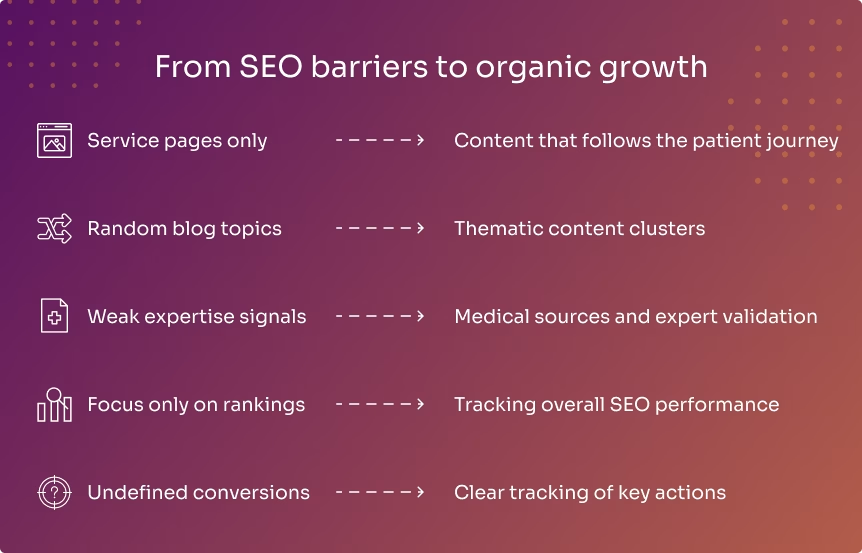
Although these lessons come from an SEO project for a private clinic, the same mistakes are common across polyclinics, dental practices, specialist medical centres and other healthcare providers
Project Lesson #12
Effective SEO for a private clinic does not depend on a single tactic. The greatest progress usually comes from removing the barriers between high-quality content, a well-structured website and clear measurement of results.
How to Prioritise SEO for a Private Health Clinic?

The London Lauriston Clinic project showed that the order in which SEO activities are approached can have a significant impact on results.
Highest Priority
The first step is to establish the foundation on which future organic growth will depend:
- a strong technical website foundation
- a clear structure for specialties, services and doctor profiles
- high-quality core commercial pages
- an accessible and clear user experience, particularly around navigation, forms and key patient information
- a content strategy based on real patient questions
- clear presentation of medical expertise and reliable medical sources
- effective internal linking between content and service pages
- accurate tracking of key interactions and conversions
Without this foundation, every subsequent SEO activity is likely to have less impact.
The Next Stage
Alongside the ongoing development of this foundation, the strategy can be expanded to include activities that further strengthen organic visibility and authority:
- continuously updating existing content
- expanding topics that are already showing organic potential
- local SEO and Google Business Profile optimisation
- further optimisation of pages that are already generating impressions and clicks
- continued improvement of the internal linking structure
Local SEO for private clinics is particularly important because many patient searches combine a treatment, specialist or service with a specific location.
For a clinic operating from a physical location, such as London Lauriston Clinic, this should not be treated as a secondary activity. Google Business Profile optimisation, local landing pages, accurate location information, reviews and other local signals can help the clinic become more visible precisely when users are searching for an appointment, specialist or healthcare provider in a particular city or local area.
Building Authority
Once a strong SEO foundation is in place, the focus can expand towards activities that build external domain authority and strengthen brand visibility:
- digital PR
- relevant backlinks
- brand mentions in trusted media and specialist sources
- video content and other multimedia formats
These activities can make a meaningful contribution to authority, but they become far more valuable when they point to a website that already has a strong technical foundation, high-quality content and clearly defined services.
When Does SEO for a Clinic Outgrow the Capabilities of an In-House Team?

A smaller clinic with one or two specialties can successfully manage part of its SEO activity in-house, particularly if it already has someone who understands content, local search and basic analytics.
Working with a specialist SEO team makes more sense when the clinic:
- covers several medical specialties
- has a larger number of doctors, services and pages that need to be connected effectively
- operates in a highly competitive market
- is developing a new website or planning a website redesign
- wants to reduce its reliance on paid campaigns such as Google Ads and Meta Ads
- already generates organic traffic but does not know which pages contribute to business results
- wants to build visibility across both traditional search and AI search
In these situations, SEO is no longer a series of isolated optimisations. A successful healthcare SEO strategy therefore needs to connect technical SEO, medical content, user experience, authority and measurement.
For more complex projects, it therefore makes sense to work with SEO specialists who understand the specific demands of the healthcare sector. This is exactly how the Ginger IT Solutions team approaches SEO for clinics: by bringing together technical foundations, content and data, with the aim of attracting relevant users through organic search and creating more valuable opportunities for them to contact the clinic.
What Did We Ultimately Learn From This SEO Project?
The London Lauriston Clinic project showed that sustainable organic growth rarely comes from one major SEO initiative. The results developed gradually through a well-built website, carefully developed medical content and continuous analysis of what users were actually searching for and how they behaved once they reached the site.
An increase of approximately 682% in organic clicks, almost 2,700% growth in impressions and an improvement in average position from 27.2 to 9.1 illustrate the scale of that progress.
The more important lesson, however, lies beyond the percentages themselves. Organic visibility grew across a range of medical topics, while educational content became some of the website’s most important entry points.
Successful SEO for a private clinic therefore does not end with strong Google rankings. Its real value comes when a prospective patient finds a reliable answer to the question that brought them to the website, understands what they can do next and develops enough trust to consider the clinic when they genuinely need professional medical care.
Ultimately, for everyone involved in this project, that is a far more meaningful goal than achieving the number one position on Google or simply appearing in an AI Overview.