
Backlinks still matter, but they are no longer the only signal shaping online authority.
As more users turn to ChatGPT, Claude, Gemini, and Perplexity for recommendations, comparisons, and buying decisions, visibility is becoming increasingly influenced by which brands appear consistently across trusted sources.
That is where brand mentions become important.
For nearly three decades, backlinks have helped Google assess page authority and determine which websites deserve to rank. They still support discovery, rankings, and referral traffic.
What has changed is how AI platforms interpret authority.
AI assistants are less focused on counting links and more focused on recognising relevance, reputation, and repeated association. A brand that appears frequently in credible conversations about a topic may gain visibility in AI-generated answers even when many of those references are unlinked.
For businesses, this is an evolution of SEO rather than a replacement. The real question is no longer whether backlinks or brand mentions matter more, but how they work together across traditional and AI-driven search.
This article explains why brand mentions are becoming more influential, why backlinks still deserve a central role, and how businesses can adapt without chasing every new SEO theory that gains traction on LinkedIn.
Key Takeaways
- Backlinks still play a critical role in rankings, discoverability, and page authority.
- Brand mentions help search engines and AI systems connect a company with specific topics, services, and areas of expertise.
- Unlinked mentions can still strengthen reputation and AI visibility when they appear across credible, relevant sources.
- Repeated mentions matter because they reinforce topical associations and reduce uncertainty around a brand’s expertise.
- Businesses should track not only how many links they earn, but also where their brand appears and which topics it is associated with.
Traditional Search vs AI Search
Traditional search engines and AI platforms often use overlapping information, but they organise and present it differently.
Traditional search engines rank webpages. Their primary task is deciding which documents deserve the most prominent positions for a particular query.
AI systems generate answers. They synthesise information from multiple sources, identify recurring patterns, compare different viewpoints, and evaluate which brands are repeatedly associated with a topic.
A company mentioned across expert articles, industry publications, comparison pages, podcasts, forums, and customer reviews may gain visibility in AI-generated answers even when many of those references do not include a link.
Google may evaluate the authority of individual pages through backlinks and other ranking signals. AI platforms are also trying to understand the wider reputation of the organisation behind those pages.
In practical terms, traditional SEO asks: Which page deserves to rank?
AI-driven search also asks: Which brands consistently appear when this topic is discussed?
That difference is one of the main reasons brand mentions are becoming more important.
Why Backlinks Became the Foundation of SEO

To understand why brand mentions matter today, it helps to understand why backlinks became so important in the first place.
Google’s original PageRank algorithm treated links as votes of confidence. Every time another website linked to yours, it signalled that the content was valuable enough to reference. Over time, this approach transformed search by rewarding authoritative, well-connected websites instead of simply matching keywords.
Although Google’s ranking systems have become significantly more sophisticated since then, backlinks remain one of the most important ranking signals because they help search engines answer several fundamental questions:
- Can this website be trusted?
- Do other reputable websites reference it?
- Is the content valuable enough for others to cite?
- Should this page appear prominently in search results?
The stronger and more relevant those links are, the easier it becomes for Google to understand that a page deserves visibility.
This is why link building has remained a core component of SEO for years. High-quality backlinks contribute to stronger rankings, increased organic traffic, faster content discovery, and greater domain authority.
The important point is that backlinks were designed to help search engines evaluate webpages and they remain exceptionally good at that job.
AI Isn’t Ranking Pages – It’s Evaluating Brands
AI assistants approach search differently.
When someone searches Google for “best project management software,” the search engine ranks webpages that are most likely to answer the query.
When someone asks ChatGPT, “What are the best project management platforms for growing agencies?” the objective changes. The goal is not simply to present a list of pages – it is to identify and recommend suitable brands.
In simple terms, Google primarily ranks documents, while AI tries to understand topics and determine which brands are most closely associated with them.
This does not mean AI ignores backlinks. Strong links help content rank, making it easier for AI systems to discover and analyse. But once that content is found, context becomes increasingly important.
AI evaluates whether a brand is consistently connected with a particular service, topic, or industry across credible sources. That is where brand mentions enter the picture.
What Counts as a Brand Mention?

A brand mention is any time a company, product, or organisation is referenced online, regardless of whether that reference includes a hyperlink.
For example, if an industry publication writes, “Many businesses choose Ginger IT Solutions for technical SEO and ecommerce optimization.” that is a brand mention.
If the publication also links to the company website, the reference functions as both a brand mention and a backlink. If no link is included, it is still a valuable brand mention that can contribute to the brand’s visibility, reputation, and association with a particular area of expertise.
Brand mentions can appear in many places, including:
- articles discussing industry leaders
- product or software comparison pages
- expert interviews
- podcasts and webinar transcripts
- conference recaps
- customer reviews
- Reddit discussions
- Quora answers
- YouTube descriptions and transcripts
- news coverage
- industry directories
Historically, many SEO professionals focused almost exclusively on linked mentions because those directly influenced Google’s ranking signals.
AI search introduces a broader perspective. The value of a mention no longer depends entirely on whether it passes link equity. Its context, source, frequency, and relevance also matter.
Repetition Turns Brand Mentions Into Topical Authority

Why Repeated Mentions Increase AI Confidence
Large language models analyse more than the presence of a company name. They consider the language surrounding the mention, the credibility of the source, and how consistently the brand appears across independent publications.
Imagine fifty different articles discussing the “best ecommerce SEO agencies.” Thirty mention the same agency, but only eight include hyperlinks.
From a traditional SEO perspective, eight backlinks carry measurable authority. From an AI perspective, all thirty mentions may contribute to a broader pattern.
Large language models generate responses by identifying patterns and estimating which answers are most strongly supported by the information available to them. When credible, independent sources repeatedly associate the same brand with the same topic, that consistency can increase confidence that the association reflects genuine expertise rather than self-promotion.
In other words, repeated mentions reduce uncertainty and make the brand a more plausible recommendation.
From Repeated Association to Entity Recognition
The repeated association between the agency and ecommerce SEO helps establish the company as a recognised entity within that topic.
This reflects one of the biggest shifts currently happening in search: authority is becoming increasingly entity-based rather than purely link-based.
Google has been moving in this direction for years through the Knowledge Graph and its focus on understanding “things, not strings.” Instead of viewing webpages as isolated documents, search engines increasingly identify relationships between people, organisations, products, and topics.
Modern AI systems take this even further. They are remarkably good at recognising that if independent sources consistently discuss a particular brand within the same context, there is probably a meaningful reason.
When a company is repeatedly mentioned alongside terms such as “ecommerce development” and “ecommerce migrations,” those associations gradually become part of how the brand is understood.
That matters because AI recommendations depend on confidence. A single mention may be incidental. Repeated, relevant mentions across credible and independent sources create a much stronger signal.
How AI Discovers Brand Mentions Through Query Fan-Out
One of the biggest misconceptions about AI search is that ChatGPT simply “knows” everything.
For many current questions, especially in search-enabled AI experiences, systems may use a technique known as query fan-out. Rather than relying on a single search, they break the original question into multiple related queries, explore relevant subtopics and sources, and then synthesise the findings into one response.
Although each platform uses its own retrieval methods, the underlying principle is similar.
When a user asks, “Which SEO agencies specialise in ecommerce?”, the AI doesn’t simply retrieve one article and repeat it. Instead, it evaluates information from several trusted sources that may include:
- industry publications
- comparison articles
- business directories
- review platforms
- news websites
- blogs
- discussion forums
- research reports
The model then looks for agreement.
- Which agencies appear repeatedly?
- Which companies are consistently associated with ecommerce SEO?
- Which names surface across independent sources rather than only on their own websites?
This pattern recognition is one of the reasons brand mentions have become increasingly valuable. The more consistently a company appears across credible sources, the easier it becomes for AI to recognise that brand as an authority within a specific topic.
Why Repeated Brand Mentions Build Stronger AI Recommendations

Imagine two agencies competing in the same market.
Agency A has accumulated hundreds of backlinks through guest posting but is rarely discussed elsewhere. Agency B has fewer backlinks, yet appears regularly in respected industry articles, conference presentations, expert interviews, software partner directories, podcasts, Reddit discussions, and “best agency” roundups.
When an AI model synthesises information from dozens of sources, Agency B may appear to have the strongest overall authority because its brand repeatedly emerges across independent conversations.
That doesn’t mean backlinks no longer matter. Quite the opposite.
Backlinks still help Agency B’s content rank in Google, making it easier for AI systems to discover those pages in the first place. The real shift is what AI values after discovery.
Rather than simply asking, “How many websites link to this page?” AI increasingly asks, “Which brands consistently appear whenever this topic is discussed?”.
That is a fundamentally different question, and it changes how businesses should think about building authority.
Brand Mentions vs Backlinks: Which Matters More Today?
The short answer is neither. Treating brand mentions and backlinks as competing ranking factors misses the bigger picture because they solve different problems.
Backlinks continue to help search engines evaluate webpages. They influence rankings, pass authority between websites, assist with crawling, and often drive referral traffic. They remain one of the strongest signals for determining whether a page deserves visibility in Google’s search results.
Brand mentions contribute to something broader. They help establish a brand as a recognised entity within its industry. Instead of signalling that a specific page is valuable, they reinforce the association between a brand and a particular topic, service, or area of expertise.
The distinction becomes clearer when comparing how Google Search and AI assistants approach the same question.
Suppose someone searches Google for: “Best ecommerce SEO agency”. Google evaluates hundreds of ranking signals before deciding which pages deserve to appear first.
Now imagine someone asks ChatGPT the same question. The goal isn’t to rank webpages – it’s to recommend businesses.
To produce a useful answer, the AI looks for recurring evidence across multiple sources. It identifies which agencies are consistently mentioned in discussions about ecommerce SEO, technical SEO, Shopify migrations, WooCommerce optimisation, digital PR, or content strategy.
When the same company appears repeatedly across credible and independent sources, AI gains more confidence that the brand has genuine expertise in that area.
That doesn’t mean every mention carries the same weight. A passing reference on an inactive blog is unlikely to have much influence, but being mentioned in respected industry publications, comparison articles, conference presentations, expert interviews, reputable podcasts, or widely cited resources tells a much stronger story.
Why Backlinks and Brand Mentions Work Better Together
Instead of thinking of backlinks and brand mentions as competing signals, it’s more useful to see them as complementary indicators of authority.
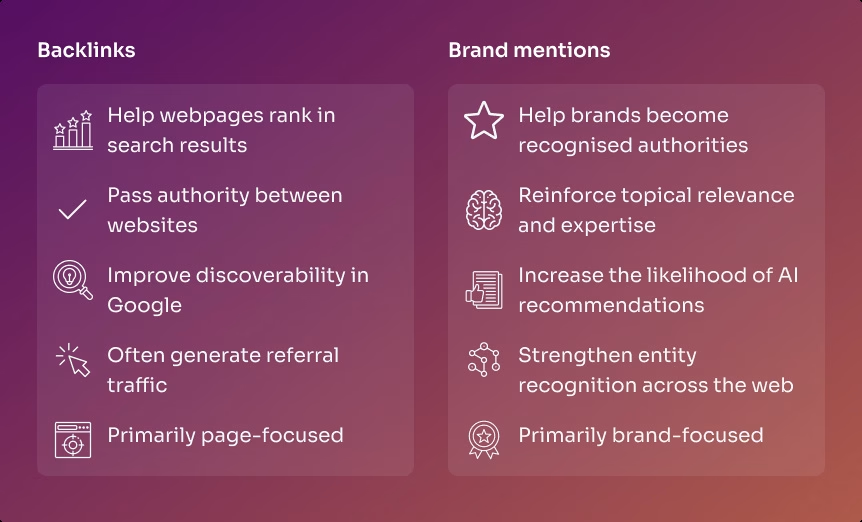
Backlinks remain essential because they help content rank, making it easier for both search engines and AI systems to discover and analyse.
Brand mentions add another layer of authority. They reinforce expertise, strengthen entity recognition, and increase the likelihood that AI associates a business with a particular topic.
The most effective SEO strategies don’t choose between backlinks and brand mentions. They build both, creating stronger visibility across traditional search and AI-powered search.
Why Unlinked Brand Mentions Are Becoming More Valuable

For years, many marketers overlooked unlinked mentions because they were difficult to measure and appeared to offer little direct SEO value. That assumption now deserves another look.
Google has long invested in understanding entities rather than simply matching keywords. Initiatives such as the Knowledge Graph, advances in natural language processing (NLP), and semantic search all point in the same direction.
Search engines are becoming better at recognising relationships between organisations, services, people, and topics instead of treating webpages as isolated documents.
Large language models build on that foundation. They analyse language, context, and recurring associations at a scale that would have been difficult to achieve only a few years ago.
Consider a private healthcare clinic that publishes authoritative content about iron deficiency and iron infusions. If the clinic is then referenced across medical publications, local healthcare directories, expert commentary, patient discussions, and relevant comparison pages, AI systems begin to see a consistent association between the organisation and that area of care.
Even when some of those references do not include a hyperlink, the repeated context still strengthens the clinic’s digital reputation and helps establish it as a recognised source of expertise.
This means earning a relevant mention on a trusted publication can still create value even when a link is not included. That represents a significant shift in how digital PR, thought leadership, and content marketing should be evaluated.
The Biggest Mistake Many SEO Strategies Still Make
SEO has constantly evolved and AI search is simply the latest shift. Yet many businesses continue measuring success using metrics that tell only part of the story.
Questions such as:
- How many backlinks did we earn?
- How much did our Domain Rating (DR) increase?
- How many referring domains do we have?
are still useful. They simply aren’t enough anymore, because the authority is becoming multidimensional.
Businesses now also need to understand:
- Where is the brand being discussed?
- Which topics is it consistently associated with?
- Are industry experts referencing it?
- Does it appear in sources AI already trusts?
- Would someone researching the industry naturally encounter the brand several times?
These questions are much closer to how real reputation works because they reflect recognition, relevance, and reputation, not just link volume.
How to Build Brand Mentions Strategically

Not every brand mention contributes equally to long-term visibility.
The goal isn’t to be mentioned everywhere. It’s to become visible where authoritative conversations about your industry are already taking place.
Many of the strongest opportunities extend beyond traditional link-building targets.
1. Start With Your Customers’ AI Prompts
Ask ChatGPT, Claude, Gemini, or Perplexity the same questions your prospects are asking.
For example:
- Best ecommerce SEO agencies
- How to migrate from WooCommerce to Shopify
- Best private clinic for iron infusions in London
Look beyond the answers themselves. Pay attention to which brands appear repeatedly and which websites AI cites as sources.
2. Target the Sources AI Already Trusts
After testing multiple prompts, you’ll notice the same industry publications, comparison sites, blogs, review platforms, and community forums appearing again and again.
Some of the strongest opportunities include:
- respected industry publications
- authoritative blogs
- independent comparison websites
- software or business directories
- trade associations
- university or research publications
- expert interviews
- conference presentations
- podcasts
- YouTube channels featuring recognised industry experts
- trusted customer review platforms
- carefully selected Reddit communities where professionals exchange advice
These should become priority outreach targets because they’re already part of AI’s information ecosystem.
3. Publish Content Worth Mentioning
The easiest brands to mention are usually those contributing something original.
That might include:
- industry research
- case studies
- practical frameworks
- expert commentary
- original data
- conference presentations
- podcasts
- webinars
- detailed guides
Original expertise earns both backlinks and brand mentions.
4. Measure Authority Beyond Backlinks
Continue tracking rankings, traffic, and backlinks, but expand your reporting to include:
- branded search growth
- media and PR mentions
- expert citations
- unlinked brand mentions
- AI visibility for important commercial prompts
- recurring publications where your brand appears
Together, these metrics provide a much more complete picture of your brand’s authority across both traditional search and AI-driven search.
Backlinks Still Matter
Every time a major change happens in SEO, someone declares that an established ranking factor is dead.
But the reality is much less dramatic. Backlinks remain one of Google’s strongest ranking signals because they help search engines assess authority, discover new pages, and understand which websites are trusted by others.
Without strong rankings, content becomes harder to find. Without discoverable content, AI systems have fewer opportunities to analyse and reference it.
In other words, backlinks continue to play an important role in the AI era. They simply aren’t the only authority signal that deserves attention now.
A helpful way to think about it is this: Backlinks help your content become visible. Brand mentions help your brand become memorable. Both contribute to long-term visibility.
AI Visibility Requires More Than Brand Mentions
There is already a temptation within the industry to reduce AI optimisation to a single tactic.
A few years ago, every problem seemed to have the same answer: build more backlinks. Today, the advice often sounds like this: “Just get more brand mentions.”
That is an oversimplification.
Visibility in both Google Search and AI-powered search results depends on many signals working together.
A strong SEO strategy still requires:
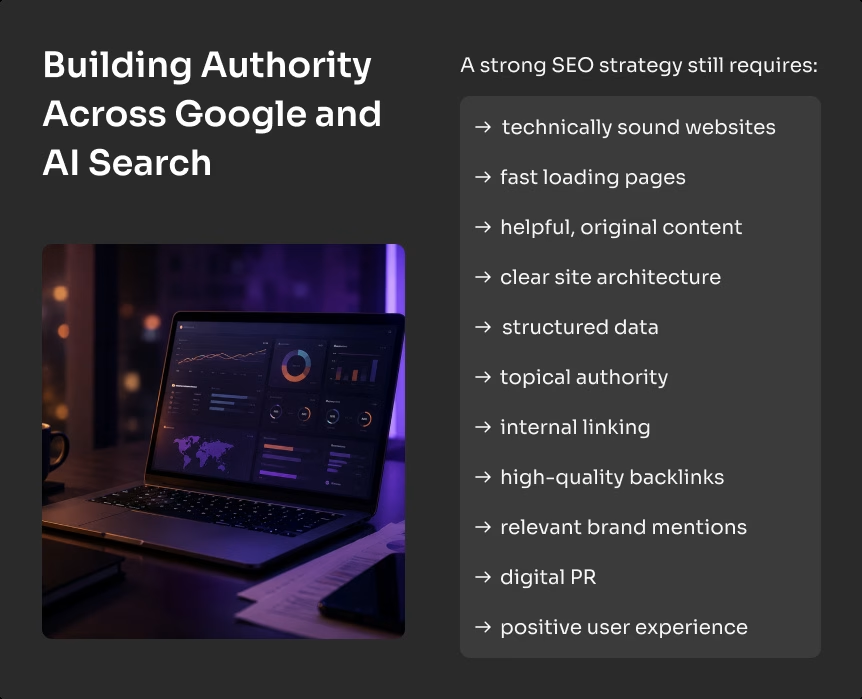
These elements reinforce one another.
Build Authority Across Search, Not Just Rankings

Publishing original research can earn backlinks from industry publications. The same piece may also generate unlinked brand mentions, media coverage, podcast invitations, expert citations, and social discussion. Each signal strengthens the others.
This is why businesses often achieve better long-term results when they work with an experienced SEO agency that looks beyond isolated tactics and develops a strategy built around sustainable authority.
Modern SEO today extends well beyond technical audits or monthly link acquisition. It requires a clear understanding of how search engines, AI platforms, digital PR, content, backlinks, and user behaviour influence one another.
At Ginger IT Solutions, our professional SEO services bring these elements together in one integrated strategy. Technical optimization, authoritative content, strategic link building, and brand-building activities are planned to improve visibility across Google and AI-powered search.
The brands gaining the most visibility today are not chasing individual ranking factors. They are consistently building expertise, authority, and trust across every channel where potential customers seek information.
That also raises an important question: is your current SEO partner adapting to these changes?
If an agency still reports only on rankings and backlinks while ignoring AI visibility, brand mentions, entity recognition, and broader authority signals, it may be time to ask whether its strategy reflects where search is heading, or whether you should reconsider that SEO partnership.
Conclusion
Backlinks are not disappearing. They remain one of the foundations of sustainable SEO and will continue to play a critical role in organic visibility.
What is changing is the broader definition of authority. Search is becoming less focused on individual webpages and more focused on identifiable entities, including brands, experts, products, and organisations.
As AI assistants become part of everyday search behaviour, repeated brand mentions across trusted and relevant sources are emerging as another powerful indicator of expertise.
This is not a battle between backlinks and brand mentions. The strongest SEO strategies invest in both.
The question is therefore no longer only: “How do we rank this page?”
It is also: “How do we become one of the brands people and AI naturally associate with this topic?”
That requires consistent expertise, credible visibility, useful resources, editorial coverage, strategic link building, and a technically strong website.
Businesses that stop investing in link building because AI has become more prominent are likely to regret that decision. Equally, businesses that focus exclusively on backlinks while ignoring broader reputation signals may find themselves absent from AI-generated recommendations, even when they rank well in Google.
The brands that understand this shift are more likely to be discovered, remembered, and recommended, whether the search begins on Google or inside an AI assistant.