
Ecommerce SEO can make or break an online store because it affects much more than rankings. It shapes how shoppers discover products, how search engines understand the catalog, how category and product pages compete, and how confidently visitors move from a search result to checkout.
For many online stores, SEO is still treated like a late-stage marketing task. Someone adds keywords to product titles, writes a few meta descriptions, publishes three blog posts, and waits for organic traffic to behave like a polite house guest. It rarely does.
A strong ecommerce SEO strategy connects search intent, technical performance, product data, category structure, content, trust signals, and conversion paths. It helps an online store attract the right visitors, give them the information they need, and make buying easier. That is where SEO stops being “traffic generation” and starts becoming a serious revenue system.
As Nedim Šabić pointed out in his Konverzija #6 talk, SEO will remain the number one marketing channel for ecommerce businesses because it generates the highest profit. Whether a store can benefit from that potential depends on how well its SEO supports the full buying journey, from first search to final purchase.
This article explains how SEO can make or break your online store’s success, and what ecommerce businesses need to get right across strategy, technical SEO, categories, products, content, and conversions.
Key Takeaways:
- Ecommerce SEO is not just about rankings. It directly impacts revenue
- Search intent should define page types and content, not keyword volume
- Technical SEO and site architecture decide what gets discovered and indexed
- Category and product pages are your main commercial assets, not just templates
- Content builds demand before users reach product pages
- Strong SEO performance comes from aligning strategy, UX, and development
- Traffic alone is not a success. Conversion is what matters.
What Ecommerce SEO Really Means for a Modern Online Store

Search Engine Land describes ecommerce SEO as the process of making an online store more discoverable by optimizing product pages, category pages, site structure, and content so shoppers can find what they need.
In practical terms, ecommerce SEO helps search engines understand what a store sells, how products are organized, which pages deserve visibility, and which search queries each page should appear for. It covers everything from technical foundations and internal linking to product descriptions, category content, structured data, product feeds, page speed, filtered navigation, mobile UX, and conversion support.
The goal is not just organic visibility. The goal is to attract high-intent traffic that can become revenue. That means reaching people who are actively researching, comparing, or ready to buy, then guiding them toward the right product with as little friction as possible.
The common mistake is treating ecommerce SEO as keyword placement. Keywords matter, of course. Search engines still need clear signals. But modern online store SEO is less about sprinkling phrases across templates and more about building a search-friendly buying journey.
A category page should help a shopper narrow a decision. A product page should answer objections before they become exits. A guide should help people choose with confidence. Technical SEO should make all of that easy for Google to access and interpret.
If those parts work together, SEO becomes a growth asset. If they fight each other, even a large product catalog can become invisible.
Why Ecommerce SEO Can Make or Break Online Store Performance
Organic search is often one of the highest-value acquisition channels for ecommerce businesses because it captures existing demand. People are already searching. The job is to appear with the right page, at the right moment, with enough clarity to earn the click and enough trust to keep it.
When ecommerce SEO is weak, the damage usually appears in several places at once. Important category pages do not rank. Product pages compete with each other. Filtered URLs create crawl waste. Product descriptions look copied, thin, or interchangeable. Blog content attracts visitors who have no buying intent. Paid campaigns start carrying too much of the growth burden. The store becomes dependent on traffic it has to keep buying.
The problem is that poor SEO often looks like a marketing issue when it is actually a business architecture issue. A messy category structure, unclear product taxonomy, slow product templates, poor mobile UX, missing stock information, or confusing checkout flow can all reduce organic performance.
Traffic alone is not the victory. Baymard Institute’s 2026 cart abandonment research reports an average documented online shopping cart abandonment rate of 70.22%, based on 50 different studies. That means many ecommerce stores are already losing a large share of shoppers after intent has been created.
SEO that brings more visitors into a weak purchase experience simply gives the store more chances to leak revenue. Ranking well and converting badly is not a success story.
Ecommerce SEO Strategy Starts With Search Intent, Not Keyword Volume

A proper ecommerce SEO strategy starts with search intent. Keyword volume is useful, but it is also very good at making people chase attractive numbers with poor commercial value.
A search for “best running shoes for knee pain” is different from “men’s waterproof trail running shoes size 10.” A search for “how to choose a coffee machine” is different from “Sage Barista Express price.” Each query reveals a different level of awareness, urgency, and buying intent. And search intent should shape page type.
- Informational queries usually belong to guides, buying advice, comparison content, or educational articles.
- Commercial investigation queries often need comparison pages, “best for” content, or curated category pages.
- Broad buying intent belongs to category and subcategory pages.
- Specific product intent belongs to product detail pages.
- Brand and model searches need clear product pages with accurate specifications, price, availability, delivery details, reviews, and return information.
This is also where AI search changes the pressure. Users are becoming more comfortable with longer, more specific queries that include multiple conditions. Aleyda Solis has argued that ecommerce SEO is shifting “from ranking pages to enabling transactions,” especially as AI systems and agents become more involved in product discovery and purchase decisions.
That shift matters. Ecommerce SEO can no longer be built around generic rankings alone. It needs to help search systems understand what the store sells, who each product is for, what buying conditions apply, and whether the merchant can be trusted.
Ecommerce SEO and Site Architecture: Make the Store Easy to Crawl and Easy to Use
Site architecture is one of the most underrated parts of ecommerce SEO. It decides how authority moves through the website, how users browse the catalog, and how search engines discover important pages.
A clean structure usually follows a logical path:
- Home page
- Category page
- Subcategory page
- Product page
Supporting content can then connect to relevant commercial pages:
- Buying guide
- Related category
- Specific products
- FAQs or support content
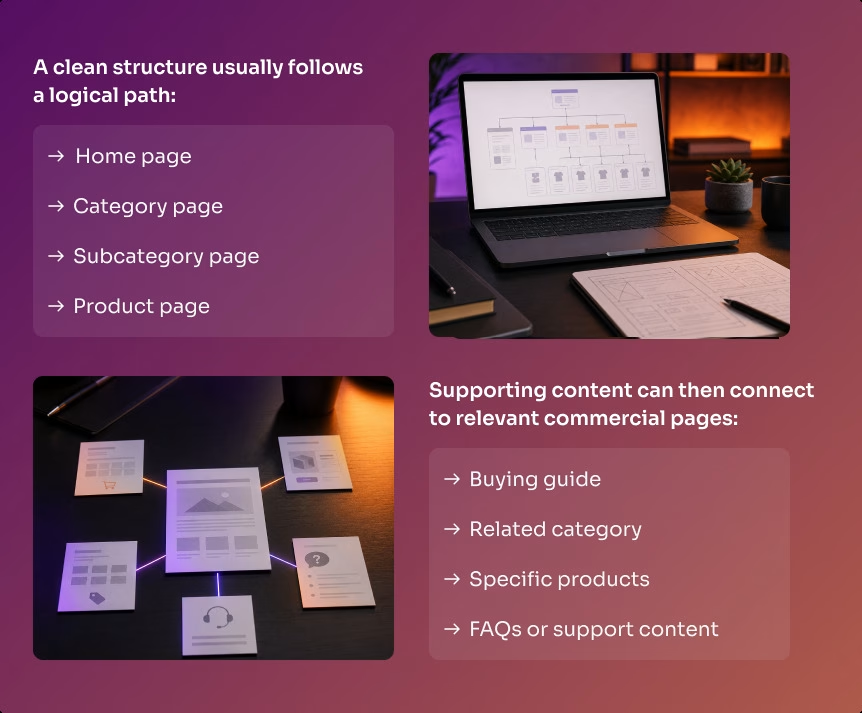
This creates a clearer journey for users and search engines. It also helps important categories receive internal links from relevant pages, rather than being buried several clicks deep behind a navigation menu nobody enjoys using.
Poor architecture creates familiar problems. Too many thin category pages. Product pages with no internal links. Duplicate category paths. Orphan URLs. Pagination issues. Filter combinations that create thousands of near-identical pages. Sorting parameters that Google can crawl but users never need from search.
Google’s ecommerce URL guidance recommends long-term, persistent URLs and warns against internally linking to temporary parameters such as session IDs, tracking codes, user-relative values, or time-based values because they can create short-lived or duplicate URLs. Google also gives specific guidance on product variant URLs so search engines can understand different sizes, colours, or other variations.
The business lesson is simple. If a store’s structure is hard to understand, search engines will not politely solve the mess. They will crawl what they can, ignore what they must, and let stronger competitors take the cleaner path.
Technical Ecommerce SEO: The Quiet Work That Protects Revenue
Technical ecommerce SEO is not developer housekeeping. It is the foundation that allows every other SEO effort to work.
An ecommerce store can have excellent content and still struggle if search engines cannot crawl the right pages, understand product variants, handle pagination properly, or distinguish valuable landing pages from low-value filter combinations.
Technical issues are especially common in ecommerce because online stores often have large catalogs, product variants, dynamic filters, stock changes, JavaScript-heavy templates, image-heavy pages, and multiple integrations.
The technical SEO essentials include crawlability, indexation control, canonical tags, XML sitemaps, robots.txt rules, structured data, mobile performance, page speed, image optimization, internal linking, duplicate content management, and clean handling of filtered navigation.
For example, if every colour, size, price filter, and sorting option creates a separate indexable URL, Google may waste crawl resources on pages that bring no real search value, while the pages that actually matter receive less attention.
This is why technical SEO in ecommerce is not just about fixing errors. It is about helping search engines focus on the pages most likely to drive qualified traffic and revenue.
Core Web Vitals deserve special attention because ecommerce pages are often heavy. Google recommends that Largest Contentful Paint should occur within the first 2.5 seconds, Interaction to Next Paint should be under 200 milliseconds, and Cumulative Layout Shift should be less than 0.1 for a good user experience.
The 2026 SEOFOMO Ecommerce SEO and AI Search Optimization Survey also shows that technical SEO remains central to ecommerce work. The survey reports that ecommerce SEO professionals continue to prioritize crawlability, indexability, site architecture, schema markup, and performance, even with the growing focus on AI search.
This is where many stores lose time. Recommendations are written. Audits are completed. Everyone agrees the issues are important. Then implementation gets stuck behind development priorities, platform limitations, or internal confusion. A beautiful SEO strategy sitting in a backlog is still just a document with excellent intentions.
Ecommerce SEO for Category Pages: Where High-Intent Discovery Usually Happens

Category pages are often the most commercially valuable SEO pages on an online store. They target shoppers who know what type of product they want but have not chosen the exact item yet.
That makes them perfect for non-branded, high-intent searches. Someone searching for “women’s leather ankle boots,” “organic face moisturiser,” or “ergonomic office chairs” is not casually browsing the internet. They are comparing options, checking brands, and deciding where to buy.
A strong category page needs more than a product grid. It should include a clear H1, useful intro copy, logical subcategories, helpful filters, relevant internal links, unique metadata, and concise supporting content that helps shoppers choose. Where appropriate, FAQs can answer practical questions about materials, sizing, delivery, compatibility, returns, care, or use cases.
The page should also be built with crawl control in mind. Filters are useful for users, but dangerous when every combination becomes an indexable URL.
A store might need indexable pages for searches with real demand, such as “black leather ankle boots” or “waterproof hiking jackets.” It probably does not need Google indexing every combination of colour, size, price range, availability, and sorting order.
The question should always be: does this filtered page satisfy a distinct search intent, offer unique value, and deserve to compete in search? If yes, build it properly. If not, keep it useful for users but controlled for search engines.
Category pages are not just product listings. They are commercial landing pages. Treating them like simple inventory grids is a quick way to lose high-value search traffic to competitors.
Product Page Ecommerce SEO: Rank, Persuade, and Reduce Doubt

Product pages sit close to the purchase decision. That makes them valuable, but also unforgiving.
A product page has to help search engines understand the item and help shoppers decide whether it is the right choice. A weak product page usually fails both audiences. It uses generic manufacturer copy, vague benefits, missing specifications, poor images, unclear availability, no delivery information, and a CTA that assumes the buyer has no questions. Buyers always have questions.
A strong product page should include a clear product name, unique description, useful specifications, price, availability, delivery information, return details, product images, reviews, FAQs, related products, and internal links back to relevant categories or guides.
In practice, the difference comes down to how the product is presented. For example, in the Martinov Design project, the focus was on translating craftsmanship into a digital experience. Each piece of furniture is showcased through detailed visuals, supported by structured content that adds context, answers questions, and strengthens SEO without disrupting the clean, minimalist design. The result is a product page that does not just display an item, but helps the buyer understand it.
Google’s Product structured data documentation explains that adding structured data to product pages can help product information appear in richer ways in Google Search, including price, availability, review ratings, shipping information, and more. Google also notes that merchant listing markup can include details such as apparel sizing, shipping details, return policy information, and product variants.
Structured data matters, but it is not magic. It helps search systems understand what is already present on the page. It will not rescue a weak product page with missing information, thin copy, or poor trust signals.
Good product page copy should answer practical buyer questions:
- What is the product?
- Who is it for?
- What problem does it solve?
- What makes it different?
- What should the buyer know before purchasing?
- What might stop someone from buying today?
Manufacturer descriptions rarely work. They are duplicated across multiple sites, written for consistency, not persuasion, and too generic to address real objections. A product page should help the buyer decide, not just repeat what is on the box.
Content Strategy for Ecommerce SEO: Build Demand Before the Product Page

Ecommerce content should not exist just to “have a blog.” That is how websites end up with articles nobody reads and rankings nobody can connect to revenue.
A good ecommerce content strategy supports the buying journey long before a shopper lands on a product page. It helps people compare options, understand differences, solve problems, and feel confident about their choices. Whether they are researching, measuring, maintaining, styling, or troubleshooting, this type of content earns visibility early and creates a natural path toward commercial pages.
Useful ecommerce content can take many forms: buying guides, comparison articles, product care and sizing guides, material breakdowns, gift ideas, use-case pages, FAQs, tutorials, and “best for” lists. The format should always follow search intent, not what is easiest to produce.
For example, a furniture store might build content around wood types, fabric care, room layouts, size guides, material comparisons, and product storytelling that brings each piece to life. A skincare store might need content about ingredients, routines, skin concerns, product layering, and seasonal care. A B2B ecommerce store might need technical documentation, compatibility guides, spec comparisons, and use-case pages.
When developing the content strategy for Astarta Parfums, a luxury niche perfume brand, it was clear that generic topics like “best perfumes for summer” would not be enough. Useful, yes, but rarely distinctive in a competitive space. Instead, the focus shifted to educational content aligned with real buyer interest. One example is a page about the most expensive ingredients in perfumes, directly connected to the brand’s use of premium materials like iris. This allowed the content to naturally lead into the product offering without forcing a sales angle.
That page still ranks among the top results and appears in AI Overviews in our region. More importantly, it brings in users who may not know the brand yet but already value craftsmanship and ingredient quality. This is where ecommerce content proves its value. It builds demand before the product page is even part of the journey.
The key is connecting content to commercial pages with intent. A guide should lead to the right category or product at the moment the reader is ready to take the next step.
This is where content reduces uncertainty. It turns “I am not sure” into “this feels like the right choice.” And that is real commercial value, even when the content itself is not directly selling anything.
Structured Data, Product Feeds, and AI-Friendly Ecommerce SEO
AI-friendly ecommerce SEO depends heavily on clarity. Search engines and AI systems need clean, consistent, machine-readable product information. That includes product names, descriptions, prices, availability, variants, shipping, returns, reviews, brand details, images, and merchant policies.
Structured data helps with this. Product schema, BreadcrumbList schema, Organization schema, review markup where eligible, merchant return policy markup, product variant markup, and accurate product data feeds all make ecommerce information easier to interpret.
Google explains that ecommerce sites can provide rich product data through Product structured data, Merchant Center feeds, or both. It also says product structured data can make product information eligible for richer search presentations, while Merchant listings can support more detailed product information such as shipping and return policy details.
This matters even more as product discovery becomes more fragmented. Shoppers no longer move simply from Google result to website to checkout. Today’s buyer journey can include around 13 different touchpoints with a brand before a decision is made, while that path used to be much shorter and more linear.
They compare products in search results, ask AI tools, watch reviews, check marketplaces, read Reddit threads, and return through branded queries. Product data needs to stay consistent across that increasingly messy journey.
Aleyda Solis notes that ecommerce SEO is becoming more cross-functional and that traffic is no longer a reliable success metric on its own, especially as AI systems influence product discovery and transactions.
The practical takeaway is clear. Structured data is the label on the filing cabinet. The cabinet still needs something useful inside. A technically correct product page with poor content is still poor. A useful product page without machine-readable data is harder for search systems to trust and present well.
Authority and Trust: The Part of Ecommerce SEO That Happens Beyond the Website

Ecommerce SEO is not limited to the website. External authority and trust signals matter, especially in competitive categories where many stores sell similar products.
Search engines and users both look for reasons to trust a business. Those reasons can include authoritative backlinks, digital PR, expert mentions, customer reviews, third-party coverage, supplier references, consistent brand information, clear policies, visible support details, and a good reputation across relevant platforms.
This is especially important for stores competing against marketplaces, established brands, and retailers with stronger domain authority. A smaller ecommerce business can still win, but it needs sharper positioning, better content, cleaner technical execution, and credible signals from outside its own website.
Link building should focus on relevance and authority, not cheap volume. A small number of strong, relevant mentions can be more valuable than a pile of links from websites nobody would willingly visit.
Trust also affects conversion. Shoppers want to know whether the product will arrive, whether returns are fair, whether reviews are real, whether support exists, and whether payment is secure. Search visibility can bring them to the page, but trust decides whether they continue.
Conversion Optimization: Because Traffic Without Sales Is Just Expensive Attention
Ecommerce SEO should not stop at rankings and clicks. Organic traffic only matters if the landing experience satisfies intent and moves buyers forward.
This is where SEO and conversion optimization meet. A category page should make it easy to compare options. A product page should reduce doubt. A checkout flow should remove unnecessary friction. A mobile experience should not punish users for having thumbs.
Important conversion elements include clear product information, visible pricing, delivery details, return policy information, reviews, trust signals, useful filters, strong images, clear CTAs, fast page experience, and simple navigation.
Baymard’s cart abandonment figure of 70.22% should make every ecommerce team take the post-click experience seriously. A large share of shoppers already leave after adding products to the cart, which means small improvements in checkout clarity, trust, delivery transparency, or payment experience can have a meaningful commercial impact.
The best ecommerce SEO work often happens after the click. Search intent either becomes revenue or quietly leaves through the checkout exit door.
This is also why SEO teams should work closely with UX designers, developers, CRO specialists, content teams, and analytics teams. A ranking improvement can increase traffic. A conversion improvement can increase revenue from the traffic the store already has. The smartest stores work on both.
Measuring Ecommerce SEO Success Without Obsessing Over Rankings Alone

Rankings matter, but they are not enough. A store can rank for the wrong terms, attract low-intent traffic, and still look successful in a shallow report.
Ecommerce SEO measurement should connect visibility to business outcomes. That means tracking organic revenue, assisted conversions, conversion rate from organic traffic, average order value, non-branded clicks, category page traffic, product page visibility, indexed pages, crawl errors, Core Web Vitals, revenue by landing page type, and changes in search visibility across important product groups.
A useful way to make ecommerce SEO reporting more practical is to measure performance by page type, not just by overall organic traffic:
- Category pages: non-branded clicks, revenue, rankings for commercial terms, filter engagement, subcategory clicks, and visibility for high-intent queries.
- Product pages: impressions, click-through rate, conversion rate, revenue, rich results, product availability, reviews, and performance for brand or model-specific searches.
- Blog and content pages: assisted conversions, internal link clicks, discovery queries, engagement, and how well they move visitors toward relevant category or product pages.
- Technical health: indexed pages, crawl errors, Core Web Vitals, duplicate URLs, structured data issues, and crawl or indexation problems that could limit visibility.
AI visibility is also becoming part of the measurement conversation. The 2026 SEOFOMO Ecommerce SEO and AI Search Optimization Survey found that 89% of respondents had started integrating AI Search Optimization into ecommerce SEO efforts, while 74% reported tracking ecommerce visibility and revenue from AI platforms.
A useful ecommerce SEO report should answer practical business questions:
- Are non-branded buyers finding the store?
- Are category pages gaining visibility for commercial terms?
- Are product pages generating qualified traffic?
- Are technical issues reducing indexation or performance?
- Are organic visitors converting?
- Which landing pages bring revenue, not just sessions?
- Where is the store gaining or losing visibility against competitors?
- Are AI platforms mentioning, citing, or referring to the brand?
The point is not to replace traditional SEO reporting with shiny new metrics. The point is to avoid pretending that rankings alone describe performance.
When to Partner With SEO Experts Instead of Patching Everything Internally
Some ecommerce teams can manage SEO internally, especially when the catalog is small, the platform is clean, and the team already has strong technical, content, and analytics resources. But as online stores grow, SEO becomes more complex. More products, more filters, more URLs, more integrations, more reporting needs, and more opportunities for small issues to become expensive problems.
That is when it often makes sense to partner with an experienced SEO agency. If organic traffic is flat despite regular content production, category pages are underperforming, technical issues keep returning, product feeds are inconsistent, or developers and marketers are not fully aligned, the problem is rarely one isolated SEO task. It is usually a wider growth and implementation issue.
Ginger IT Solutions supports ecommerce businesses through a complete SEO approach that includes SEO audits, on-page optimization, technical SEO, content strategy, link building, competitor analysis, and ongoing performance monitoring. The focus is not simply on rankings, but on attracting qualified traffic, improving user experience, strengthening authority, and turning organic visibility into measurable revenue.
For growing stores, investing in professional SEO services is about bringing strategy, technical execution, content planning, analytics, and development priorities into the same conversation.
There is also a point where the website itself becomes the constraint. If the platform is slow, templates are inflexible, product data is messy, or the checkout flow creates friction, SEO and development need to work together.
This is where Ginger IT Solutions’ ecommerce development team can support the bigger picture, from ecommerce architecture and UX to payment processing, shipping, inventory management, product information, and long-term growth requirements.
Strong ecommerce performance does not come from SEO or development in isolation. It comes from a store that search engines understand, users trust, and the business can scale.
Conclusion
Ecommerce SEO is not one tactic. It is the combined effect of strategy, technical foundations, category structure, product page quality, content, structured data, authority, UX, and conversion performance. That is why ecommerce SEO works best when the whole store works better.
Search engines reward clarity. Shoppers reward usefulness. A successful online store needs both.
The strongest ecommerce SEO strategies are built around how people actually search, compare, hesitate, and buy. They make the catalog easier to crawl, the pages easier to understand, the products easier to evaluate, and the checkout easier to complete. That is how SEO moves from visibility to revenue.
For business owners, the real question is not whether ecommerce SEO matters. It does. The better question is whether the current store is giving search engines and shoppers enough reasons to choose it over the alternatives. If the answer is unclear, that is usually where the work starts.
If your online store is visible but not converting, or converting but not visible enough, Ginger IT Solutions can help connect ecommerce SEO, technical execution, and ecommerce development into one clear growth strategy.