
People who visit a private clinic website rarely have much patience for exploring the organization itself. They usually arrive with a specific reason for being there. They may be looking for a particular doctor, trying to understand which type of appointment they need, checking how to prepare for a procedure, or simply trying to find a phone number and book an appointment as quickly as possible.
That is why a website for a clinic or other healthcare provider has a different job than most business websites.
For a private clinic website, looking professional is not enough. The website needs to help users reach the right information quickly, communicate the expertise of the medical team clearly, build trust and make the next step simple, whether that means learning more, finding the right specialist, contacting the clinic or booking an appointment.
Through our experience of developing websites for healthcare providers, we have also seen something that is often overlooked: much of a website’s future success is determined long before it goes live.
The way specialties, services, and doctors are organized has a direct impact on the user experience. How doctors are presented, and the quality of their profile pages, influence trust. Typography, contrast, navigation, and interactive elements all affect accessibility.
The structure of the CMS determines how easily the website can support future content growth, including new services and educational articles, without becoming difficult to manage only a few months after launch. These are all decisions that need to be made during the planning, design and development stages.
The same applies to SEO. If organic visibility is only considered once the website is finished, the first stage of SEO often becomes an exercise in fixing decisions that have already been built into its structure. When SEO is considered from the outset, the website can be developed to support future content growth, new services and the different ways potential patients may discover it through search.
We saw this particularly clearly with the London Lauriston Clinic project, where Ginger IT Solutions handled both the web design and website development, with SEO included in the planning from the very beginning. That alone did not guarantee the organic growth that followed, but it did mean that the SEO strategy did not have to begin by correcting fundamental architectural and technical issues. Instead, it could build on a system that had already been designed with future growth in mind.
In this guide, we will therefore look beyond how a private clinic website should look. We will focus on the planning, design and development decisions that determine how useful the website will be to patients over time, how easy it will be to manage, and how well prepared it is for future SEO and content growth.
What Makes a Private Clinic Website Different From a Standard Business Website?
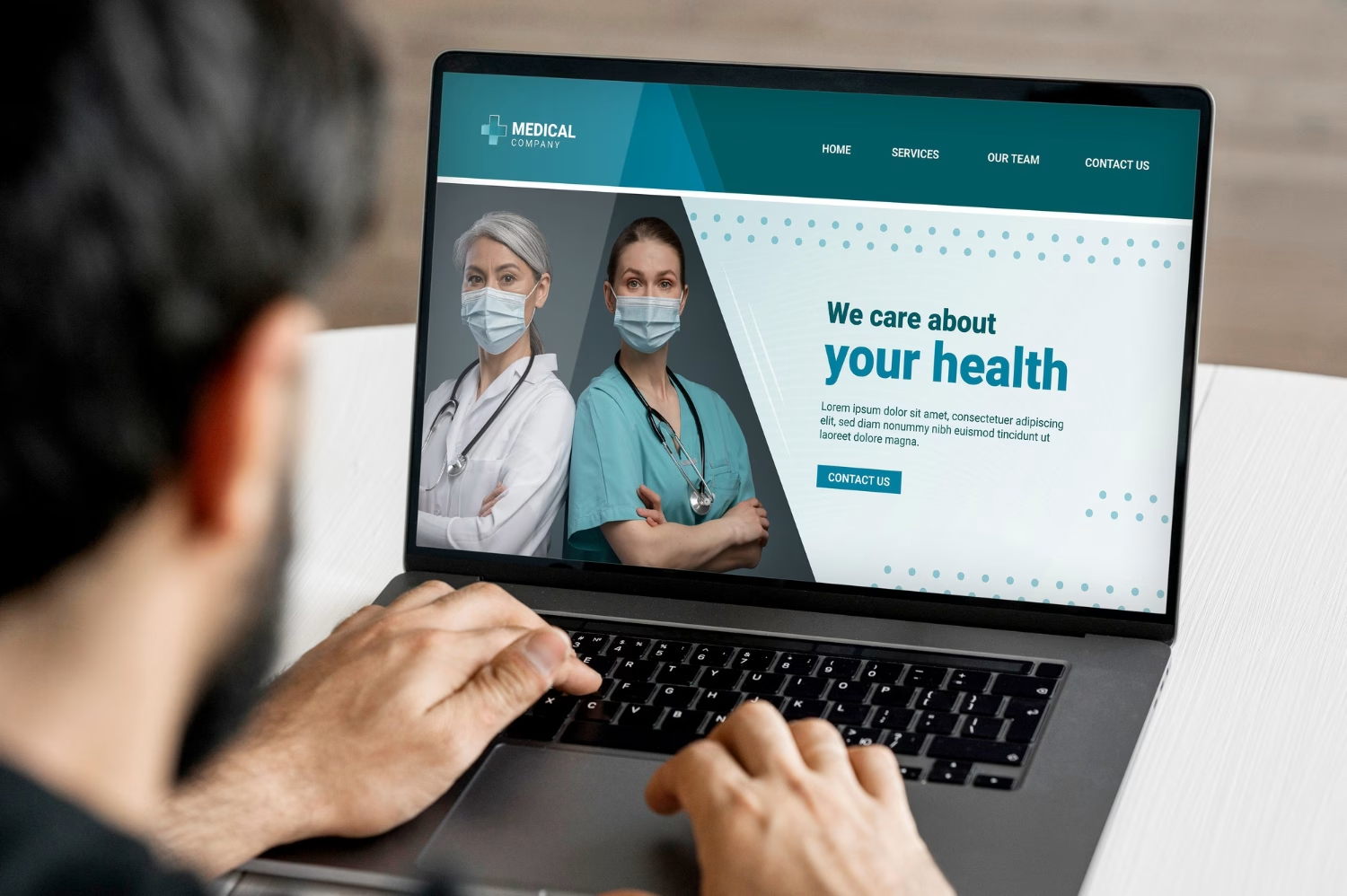
On most business websites, visitors come to learn more about an offer, compare a few options, or submit an inquiry. For healthcare providers, the context is often quite different.
A visitor may be worried about a symptom, looking for a doctor in a particular specialty, or trying to find somewhere to have a recommended examination or test. That intent changes the way the entire website needs to be approached.
Information about specialties, appointments, treatments and doctors should be easy to find without forcing users through complicated navigation. Medical content needs to be authoritative enough to inspire confidence, while still being clear and easy for patients to understand. The clinic’s address, opening hours, phone number, and booking options should never be difficult to locate.
Trust is particularly important on healthcare websites. With a conventional product or service, more direct and assertive sales language can sometimes help improve conversions. In healthcare, however, exaggerated promises, sensational claims, and promotional messaging without sufficient context can have the opposite effect.
Patients want to know who will be treating them, what that doctor specializes in, which services the clinic actually provides, what they can expect from an appointment, and how they can ask a question or book a consultation.
For that reason, a healthcare website project should not begin with the question: What do we want the website to look like?
A better starting point is: What do different visitors need to find and do on this website, and how can we help them do it with as little friction as possible?
Once we have a clear answer to that question, the design will have a much stronger foundation.
Technical SEO Starts Before Launch
SEO is sometimes treated as something that begins only after a website goes live, when the SEO team steps in and keyword research starts. In practice, much of the technical SEO foundation is determined much earlier.
Site architecture, URL structure, page indexability, canonical tags, breadcrumbs, internal linking, structured data, mobile experience and performance are development decisions just as much as they are SEO decisions.
If these elements are only considered after launch, the first stage of SEO optimization often becomes an exercise in fixing the structure of a website that has already been built.
With the London Lauriston Clinic project, the Ginger team was in a different position. Because we were able to plan the design, development and SEO together, the structure of specialties and services, doctor profiles and the technical foundation of the website were all built with future organic growth in mind.
This did not guarantee SEO results on its own, but it removed some of the obstacles that, on other projects, can later consume significant time through changes to basic site architecture, indexation or page structure.
The subsequent organic growth of the London Lauriston Clinic website cannot be attributed to any single development decision. It came from a combination of a strong technical foundation, high-quality content, and ongoing SEO optimization. That is also one of the main lessons from our detailed SEO case study of the project.
In other words, a website should be developed so that future optimization can build on a solid foundation, rather than repeatedly fixing problems that were built into its structure from the start.
The Website Needs to Support Content Growth

Search is one of the main ways many private healthcare clinics are discovered by prospective patients, but users will not always search for the clinic’s name or for a specific service.
Sometimes the search begins with a symptom, sometimes with a test result, and sometimes with a question about an examination, procedure, or treatment. That is why a clinic website should be built from the outset to support different stages of this research process.
Service pages are important when users already know what they are looking for, while educational content can play an important role much earlier, when they are still trying to understand a problem or identify the right type of care.
The London Lauriston Clinic project provided a clear example of this approach. During the later stages of SEO work, educational articles became some of the website’s most visited organic landing pages, while visibility expanded across a broader range of interconnected medical topics.
We have already covered the choice of topics, organic growth and SEO results in detail in a separate case study. From a website development perspective, however, the other side of that story is just as important: new content needs to have a clear place within the site structure, connect logically with relevant services and specialists, and be easy to update and expand over time.
If the blog, doctor profiles, and service pages are not designed from the start to support ongoing growth, the content strategy can quickly become shaped by the limitations of the website rather than by user needs and the SEO strategy.
Location Should Be Built Into the Site Structure From the Start
A private clinic is a physical healthcare provider, so location plays an important role in local search and can also influence a patient’s decision. Users are not always looking only for a particular treatment or appointment type. They may be looking for it in a specific city or neighborhood.
That is why the clinic’s address, phone number, opening hours and directions should be easy to find and presented consistently across the website. If a clinic operates from multiple locations, it often makes sense for each one to have its own well-structured page.
That page can show users which services are available at that location, which doctors work there, the opening hours and how to contact the clinic.
In this way, the website answers two important questions:
What does the clinic provide?
Where can I access that service?
When the relationship between services, specialists and locations is planned from the outset, future local SEO has a much stronger foundation to build on.
Forms, Analytics and Privacy Should Be Planned Together
Once a website is live, it is important to understand how users find it and what they do once they arrive. Which pages do they visit most often? Which services bring them in through search? Do they move from doctor profiles to booking? How often do they click a booking CTA or visit the contact page?
For that reason, decisions about which behaviors we want to measure should not be left until after launch.
During the planning stage, it is worth defining which actions should be treated as important events and potential conversions. Depending on how the clinic and its booking process work, these might include a phone call, a click on an email address, a completed contact form, opening the booking system, or successfully scheduling an appointment.
London Lauriston Clinic provided a useful practical lesson here as well.
Later SEO data could clearly show growth in organic traffic and user engagement, but the existing setup did not allow us to reliably connect that growth with a specific number of booked appointments. At the client’s request, the contact page was built without a traditional contact form, which meant that part of the user journey from an organic visit to an actual booking could not be measured directly.
Analytics, therefore, is not simply a question of which tool to install. During the user experience planning stage, we also need to understand which actions we want to track, what constitutes a meaningful conversion for the clinic, and whether the way forms, booking systems and other contact channels are implemented actually allows those actions to be measured reliably.
In healthcare, there is another important layer to consider: privacy.
Data Privacy Needs to be Part of Development From the Start
Data should not be collected simply because it is technically possible to collect it. Every piece of information requested from a user should serve a clear purpose, and this is particularly important on healthcare websites.
In the UK, data revealing information about a person’s physical or mental health falls within a specially protected category known as special category data. The principle of data minimization also means that any personal data collected should be relevant and limited to what is genuinely necessary for a specific purpose.
This has very practical implications for form design.
If a name, preferred contact method, and basic information about the service a patient is interested in are enough for an initial inquiry, there is little reason to request a large amount of additional information upfront. Those details can be collected later through a more appropriate and secure process where necessary.
The same principle should apply when choosing analytics tools, chatbot solutions, booking systems, and other third-party integrations. They should not be assessed solely on functionality but also on what data they collect, how that data is processed, and whether collecting it is genuinely necessary.
Privacy and security are therefore not issues to address on the final day of a project. They influence decisions about functionality, integrations, forms and data collection from the very beginning.
Lesson from the project
What we fail to define before launch is often difficult to measure reliably afterwards. For healthcare websites, the user journey, analytics, privacy and technical implementation should therefore be planned as connected parts of the same system, rather than treated as separate concerns.
The Website Needs to Be Built for Change
A healthcare website evolves alongside the organisation itself. New doctors join the team, new services are introduced, locations and appointment times change, new expert content is published, and existing medical information needs to be reviewed and updated from time to time.
That is why, during the planning and development stages, it is important to think about how the clinic team will actually use the website after launch. If every new doctor, service update or content connection requires developer support, the website will quickly become difficult to maintain.
A good CMS therefore means more than simply allowing someone to edit text. It should enable the team to add and update content without disrupting the structure of the website and without turning every small change into a development task.
At the same time, user behaviour after launch should help shape future improvements.
A particular service page may attract a large number of visitors but lack a clear next step. Users may frequently arrive directly on doctor profile pages. An educational article may also become a more important organic entry point than the service page itself, as happened on the London Lauriston Clinic website with the article on iron infusion benefits and risks and the guide to iron levels that may indicate the need for an infusion.
During the SEO project, educational content became some of the website’s more important entry pages and, in certain cases, generated stronger user engagement than the main service pages.
A well-built website should therefore do more than support what the clinic needs at the time of launch. It should give the team enough flexibility to respond to new services, changes in user behaviour and insights from SEO and analytics without having to rebuild the site’s core structure every time something new is learned.
What We Learned From a Private Clinic Website Project in London
If we had to reduce our experience with healthcare projects to one lesson, it would be this: the quality of a website does not depend on a single element or priority. The strongest results come when content structure, UX, design, development, accessibility, performance, SEO and analytics all support the same goal.
With the London Lauriston Clinic project, we were able to observe that relationship over a longer period, from the initial planning and development of the website through to its later organic growth.
The project’s SEO case study showed significant growth in clicks, impressions and user engagement. More importantly, however, it showed that this growth did not come from a single page or a single intervention. It happened on a website that was able to support content expansion, connections between related medical topics and the different ways users arrive in search of information.
That does not mean that every decision made during development directly caused the later SEO growth. The results came from a combination of factors and ongoing work. What the project does show clearly is why it is useful to think about what happens after launch while the website is still being planned and built.
Users will not always arrive on the homepage from a desktop computer and carefully work their way through the main navigation. One person may visit from a mobile phone and only want to find the contact details. Another may have impaired vision or navigate using a keyboard. Someone may land directly on an educational article from Google, while another user may discover a doctor profile first and only then explore the clinic’s services.
A good healthcare website needs to work across all of these scenarios.
And ultimately, trust is not built through one grand claim on the homepage. It is built through a series of smaller decisions: authentic, high-quality photography, clear doctor profiles, understandable descriptions of examinations and treatments, medically reviewed content, transparent contact information, simple navigation, an accessible interface, predictable form behaviour and a website that is fast and stable.
When all of these decisions work together as part of the same system, the website becomes more than a visual presentation of the clinic. It becomes a digital foundation that can support patients, the clinic team and continued organic growth.
What Should a Good Private Clinic Website Achieve?
The quality of a clinic or healthcare website should not be judged only by how modern it looks the first time someone opens it. A more important question is what happens when a prospective patient actually arrives on the site.
Can they quickly understand which services the clinic provides? Can they find the right doctor? Does the information they read feel clear, professional and trustworthy?
If they arrive directly from Google on a service page or educational article, do they understand where they are and what they can do next? Can they easily find the clinic’s location, contact details and information about booking an appointment?
If the answer to those questions is yes, then design, development, content, accessibility, analytics and SEO are no longer functioning as separate disciplines. Together, they create an experience that helps users find the right information, build confidence in the clinic and take the next step.
That is how we approach website development for clinics and healthcare providers at Ginger IT Solutions. We do not see it simply as a project that results in a new visual presence online, but as the development of a digital system designed to support patients, the clinic team and future growth.
If you are planning a new website or a redesign of an existing healthcare platform, SEO, UX, content and the technical foundation are best considered from the very beginning. This gives the website a much better chance of remaining useful to patients, easy to manage and ready to support future growth.