


The real value of ecommerce SEO is not simply higher rankings or more organic traffic. It is whether organic search brings the right shoppers into the right parts of the store and contributes to product discovery, conversions and revenue.
Rankings, impressions and clicks still matter, but they are indicators rather than business outcomes.
An ecommerce site can double organic traffic through informational content and see little change in sales. Another may grow traffic more modestly while gaining visibility for high-intent category and product searches that generate considerably more revenue. The second result may be far more valuable.
A practical way to measure ecommerce SEO is to follow the customer journey:
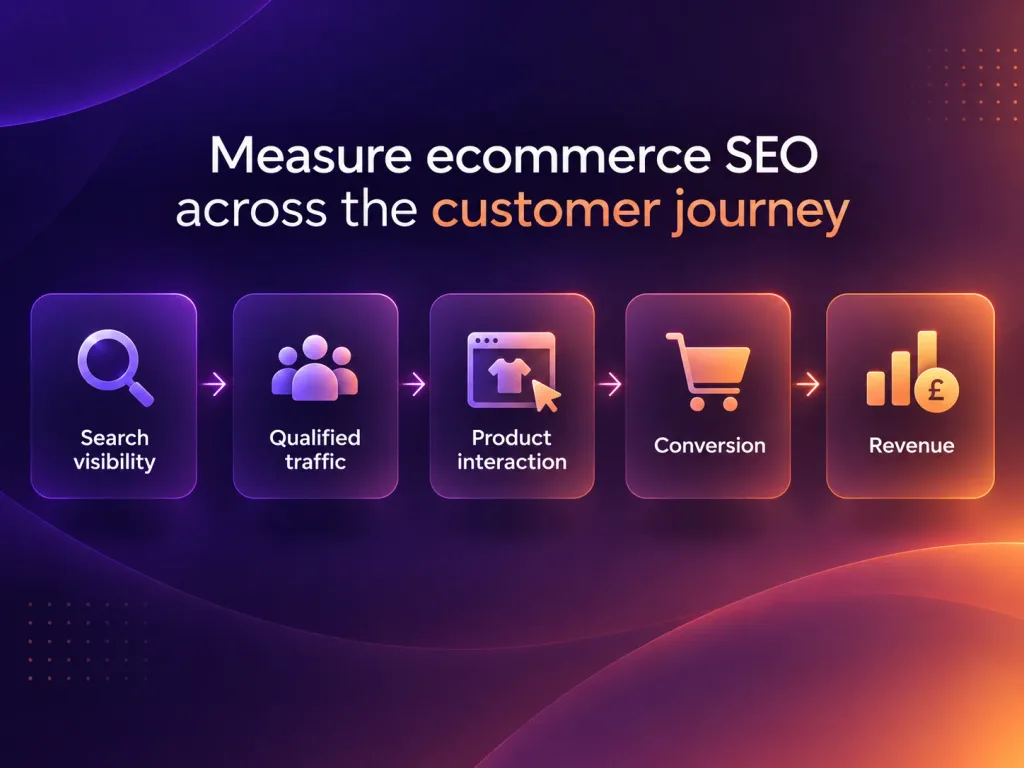
Each stage answers a different question. Together, they show whether SEO is contributing to the business rather than simply producing larger numbers in a report.
Key Insights
- Rankings and traffic are starting points, not business outcomes.
- Commercial and non-branded visibility often tells more than total organic growth alone.
- Category pages, product pages and editorial content should be measured differently because they perform different jobs.
- Product interaction helps reveal whether organic traffic is genuinely qualified.
- Revenue needs context. Stock, pricing, promotions, seasonality, competition and brand demand can all influence the result.
- SEO results should be measured against the work that was actually done. A technical fix, category restructure and buying guide should not be judged by exactly the same metrics.
These principles sit within a broader ecommerce SEO strategy, where content, technical SEO, category architecture, product presentation and UX all influence how much value organic visibility can ultimately create.
Which Ecommerce SEO Metrics Actually Matter?
No single metric can explain the entire customer journey. A useful measurement framework connects each stage of organic performance with a different business question.
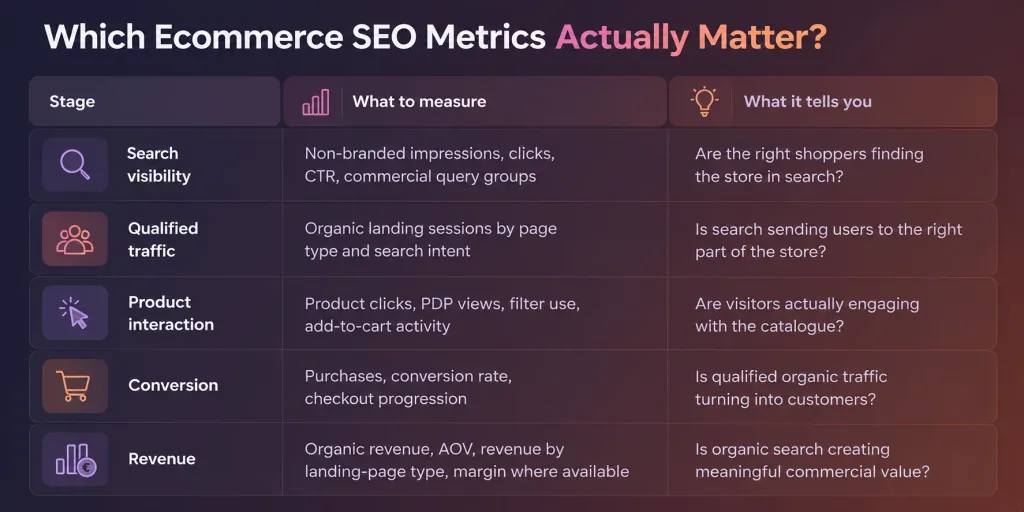
Google Search Console is useful for understanding visibility through impressions, clicks, CTR and average position. But those numbers need commercial context.
Moving from position eight to position four for a valuable product category can matter considerably if it brings more qualified shoppers into the store. Ranking first for a broad informational query may generate far more traffic while contributing much less directly to sales.
Instead of asking only: How much did organic traffic grow?
Ask: Which searches generated that growth, where did users land, and what happened afterwards?
How Do You Measure Commercial Search Visibility?
Not all organic demand tells the same story.
Branded searches generally come from people who already know the business. Non-branded searches can show whether SEO is helping the store reach shoppers who are actively looking for its products but have not necessarily chosen a brand yet.
Rather than monitoring hundreds of keywords individually, group commercially important searches by theme.
For an online furniture store, those groups might include:
- dining tables
- solid wood furniture
- custom furniture
Then check whether the correct pages are appearing.
If an informational article repeatedly ranks for a transactional query, the site may have a search-intent or internal-linking problem.
If two categories keep replacing each other for similar searches, their purpose may overlap.
If a product page ranks for a broad product-group query, the relevant category may need stronger relevance or internal support.
This is an important part of category page SEO: visibility is more valuable when searchers reach the page best suited to what they actually want. The goal is to have the right page rank for the right search.
Should Category Pages, Product Pages and Blog Content Use the Same KPIs?
No. They perform different jobs.
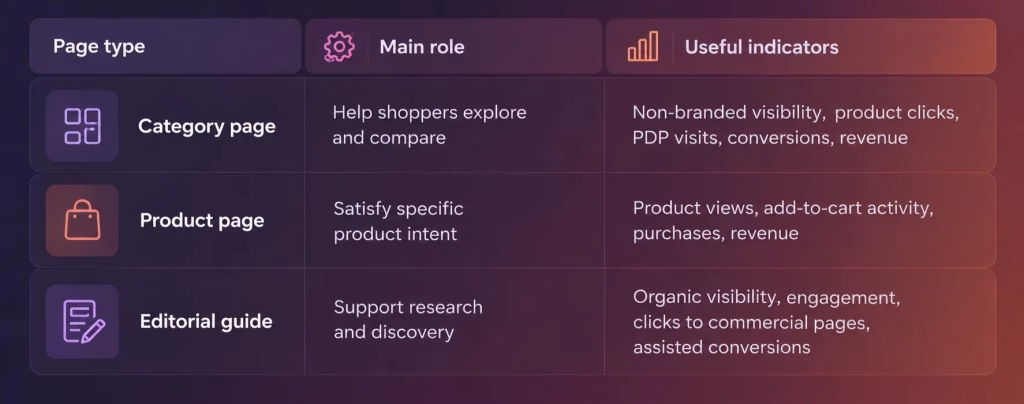
Consider Martinov Design. The guide on how to choose a dining table answers questions that arise while someone is researching dimensions, materials and practical requirements. The dining tables category gives that shopper actual products to compare.
Both pages can contribute to the same customer journey, but success looks different.
The guide should help users understand their options and move towards relevant products. The category should help them compare those products and progress into PDPs.
A high-performing product page sits much closer to the purchase decision, so product engagement, add-to-cart activity and conversion usually matter more than traffic volume alone. This is why segmenting organic performance by page type often reveals far more than total traffic alone.
How Do You Know Whether Organic Traffic Is Qualified?
The space between traffic and revenue is where ecommerce reporting becomes particularly useful.
When ecommerce tracking is implemented correctly, GA4 can show whether organic visitors view product lists, select products, visit PDPs, add items to cart and progress towards checkout.
For category pages, useful questions include:
- Are organic visitors actually clicking into products?
- Which categories send the highest share of users into PDPs?
- Are visitors adding products to their carts?
- Which categories attract strong search traffic but weak product engagement?
Consider two categories. One receives 5,000 organic sessions but produces very few product clicks. Another receives 2,000 sessions but sends a much larger share of visitors into PDPs and generates considerably more add-to-cart activity.
Traffic alone makes the first category look stronger. Commercial behaviour may tell a very different story.
If a category attracts plenty of organic traffic but few visitors continue into products, the problem could be search intent, the product assortment, missing information, weak product visuals or unnecessary UX friction.
The goal is not to track every possible event. Focus on actions that represent meaningful progress towards purchase.
How Should You Measure SEO Revenue?

Ultimately, ecommerce SEO has to connect with commercial results.
Useful metrics may include:
- organic purchases
- ecommerce conversion rate
- purchase revenue
- average order value
- revenue by category
- revenue by landing-page type
But revenue should never be interpreted in isolation. If organic revenue increases, ask what else changed.
Was a bestselling product back in stock? Was there a major promotion? Did prices change? Did another marketing channel create additional branded demand? Did seasonal interest peak during the same period?
The opposite is equally important. Organic visibility can improve while revenue declines because key products are unavailable or market demand has weakened.
SEO operates inside a larger commercial system.
For more mature stores, reporting can go further by considering margin, returns, stock availability and customer value. The product or category generating the most revenue is not necessarily the most profitable SEO opportunity.
Attribution also has limits. A customer may discover the store through a non-branded organic search and return later through another channel before purchasing.
SEO should therefore be evaluated as part of the wider customer journey, rather than only through last-click revenue.
SEO Performance Never Exists in Isolation
After more than a decade of SEO work, one thing becomes very clear: organic performance is almost never the result of SEO changes alone.
Strong SEO needs something worth discovering. That includes a technically reliable website, useful content, a competitive product offer, good product presentation and a brand shoppers trust.
Market conditions matter too. Search demand can rise or fall. Competitors can improve their websites, launch stronger products or invest in content. SERPs change. Prices change. Consumer behaviour changes.
This is why a ranking decline does not automatically mean that SEO work failed, just as revenue growth does not automatically prove that SEO caused it.
Good measurement looks for relationships between:
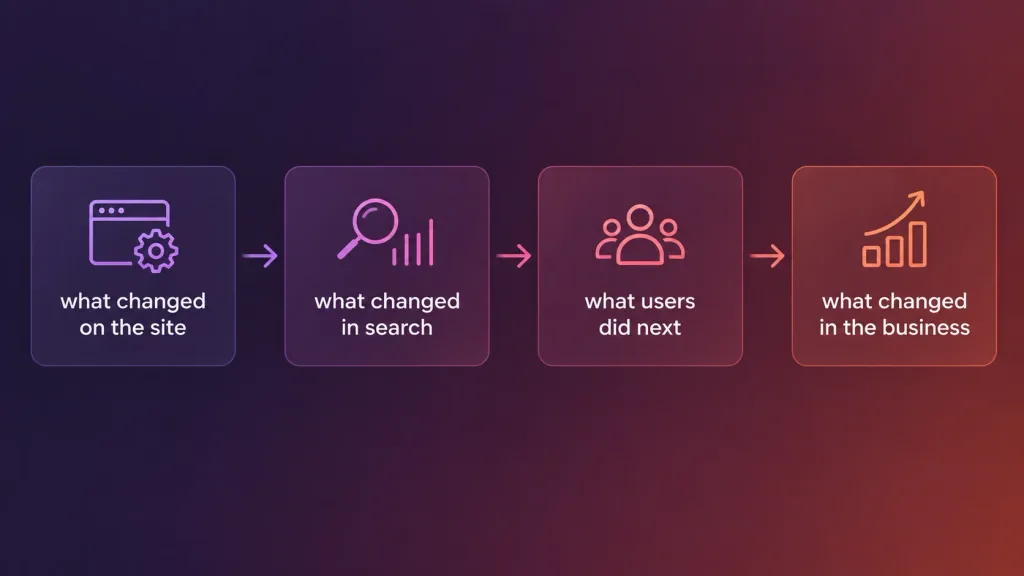
That requires context, not just dashboards.
How Long Should You Wait Before Measuring Ecommerce SEO Results?
There is no universal timeframe after which SEO should be declared successful or unsuccessful.
A technical indexing fix may produce measurable changes relatively quickly. Category restructuring, content development, authority building or broader technical improvements can take considerably longer to show their full commercial effect.
The evaluation period should match the work being measured.
A 90 days before vs 90 days after comparison can be useful for some changes.
For strongly seasonal stores, comparing the same period year over year is often more meaningful. If a category is optimised in November and revenue increases in December, comparing it only with October risks crediting SEO for Christmas.

Other variables should also be documented, including:
- promotions
- stock changes
- price changes
- migrations or redesigns
- tracking changes
- paid campaigns
- product launches
- seasonal demand
- major competitor changes
The goal is not to attribute every result with absolute certainty, but to be realistic about what the data can actually tell us.
Connect SEO Action With Expected Business Outcomes
At Ginger IT Solutions, ecommerce SEO measurement is most useful when the expected outcome is defined before the work begins.
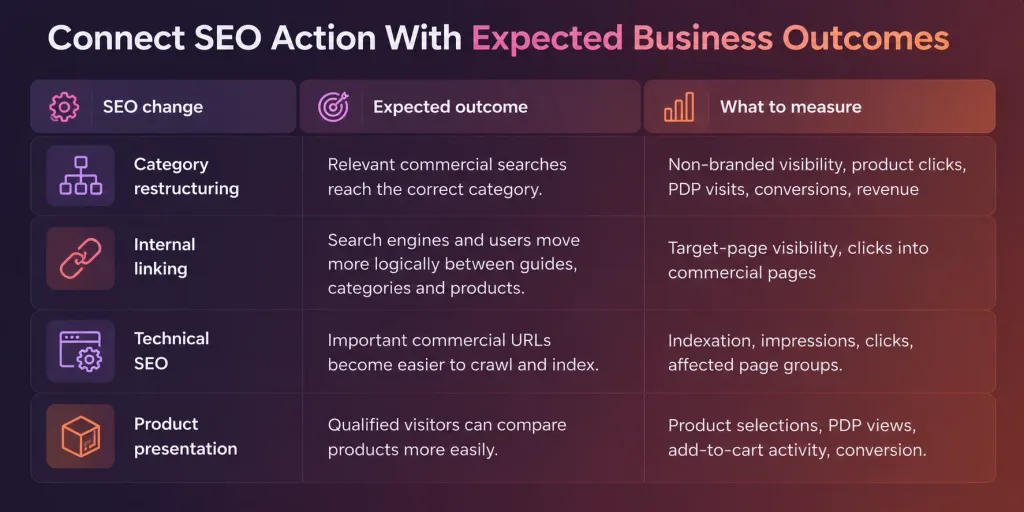
This prevents reporting from becoming disconnected from the work itself.
A technical SEO change should not be judged only by immediate revenue. A buying guide should not be judged only by last-click purchases. A category restructure should be evaluated across the page group and search intent it was designed to improve.
What Do Different Ecommerce SEO Results Actually Mean?
Metrics become useful when they help explain what might need attention next.
Visibility is up, but traffic is flat.
Review CTR, SERP appearance, ranking position and whether the page matches the queries generating impressions.
Traffic is up, but product interaction is weak.
The traffic may not be sufficiently qualified, or the category may not meet the expectation created in search. Review intent, product selection, filters, product information and UX.
Product interaction is strong, but conversions are weak.
The problem may sit later in the buying journey. Pricing, availability, product pages, shipping, trust signals or checkout friction may deserve attention.
Rankings are stable, but revenue is down.
Look beyond SEO at demand, stock, prices, competitors and seasonality.
Revenue is up, but search visibility has barely changed.
Do not automatically credit SEO. Promotions, average order value, returning customers or increased branded demand may explain part of the growth.
Several pages keep alternating for the same queries.
Cannibalisation or unclear page roles may be limiting performance. Review search intent, category overlap and internal linking.
What matters is not just noticing that a metric changed, but understanding what combination of factors could reasonably explain that change.
Search Console and GA4 Answer Different Questions
Search Console and GA4 measure different parts of the journey.
Search Console answers: What happened in Google Search?
GA4 answers: What happened after visitors reached the website?
Search Console may show that a high-value category gained more non-branded impressions and clicks. GA4 can then show whether those additional visitors selected products, added items to cart and purchased.
In simple terms, Search Console shows whether search is creating the opportunity. GA4 helps show what happened with that opportunity once the visitor arrived.
Their numbers will not always match, and they do not need to.
What Should an Ecommerce SEO Report Actually Show?

A useful ecommerce SEO report should answer a few commercially useful questions:
- Did visibility improve for the searches that matter?
- Are the right categories, products and guides attracting that demand?
- What did organic visitors do after landing?
- Did product engagement, conversions and revenue improve?
- What should be improved next?
That final question is what separates reporting from analysis.
“Organic traffic increased by 15%” gives the business a number. “A high-value category gained non-branded visibility, attracted more qualified visitors, generated more product views and contributed more revenue” explains what changed and why it matters.
Reporting should lead to decisions.
Measure Ecommerce SEO as a Business Channel
There is no single metric that can prove whether ecommerce SEO is working.
Rankings show visibility. Clicks show whether search demand is reaching the store. Product interactions show whether visitors engage with the catalogue. Conversions and revenue show commercial outcomes.
Each metric explains only one part of the journey.
A more useful framework is:
Search visibility → Qualified traffic → Product interaction → Conversion → Revenue
At Ginger IT Solutions, ecommerce SEO is considered alongside UX, content, analytics, technical SEO and ecommerce development because organic performance depends on how the whole store works, not simply on what an SEO tool reports.
When these elements and metrics are considered together, ecommerce SEO stops being a report about rankings and sessions. It becomes a way to understand how organic search contributes to product discovery, customer behaviour and business growth.
That is the business value ecommerce SEO should ultimately be measured against.