


If you are working in a creative field, in the past couple of years you’ve probably been a part of a conversation or two about the position and future of creativity. We can’t deny there’s a quiet shift happening in how we perceive and receive creativity.
Not that long ago, creativity was something distinctly and entirely human. It came from experience, emotion, weaknesses, and the perception of humans.
AI is challenging that assumption.
Tools powered by artificial intelligence can generate headlines, design layouts, write code, and even mimic artistic styles in seconds. What used to take hours, sometimes days, can now be done almost instantly.
So the real question isn’t just what AI can create. It’s what happens to creativity when it’s no longer limited to humans.
For anyone working in digital marketing this isn’t a theoretical debate, and it hasn’t been for quite some time. It’s already shaping how work gets done, how content is produced, and how ideas are evaluated and executed.
To understand where creativity is going, we first need to understand how AI is reshaping it today.
What We Talk About When We Talk About Creativity
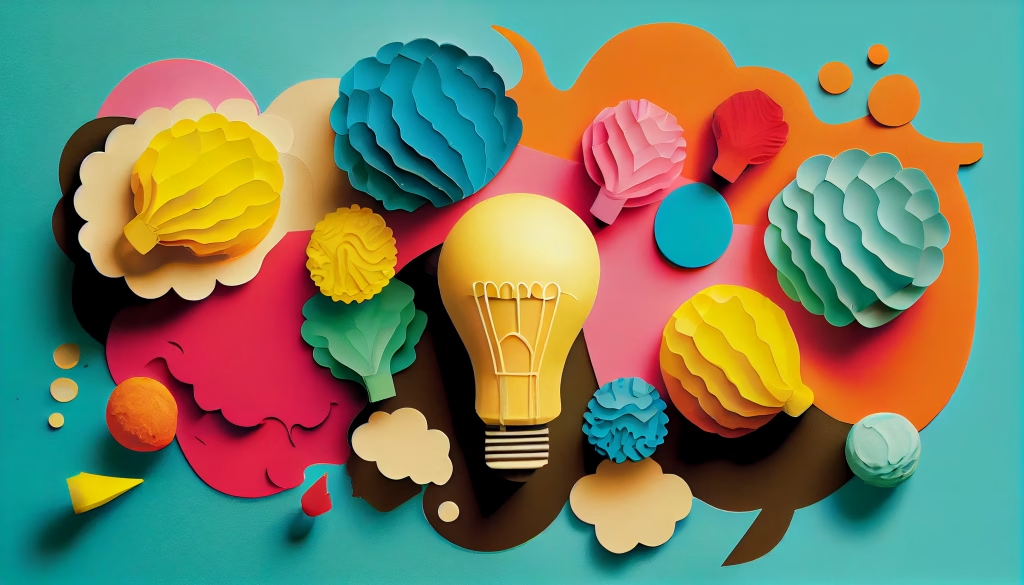
Wikipedia defines creativity as the ability to generate novel and valuable ideas, but that is just the theory. In practice, creative work is valuable because it solves a problem, communicates something clearly, or makes an idea stick.
A piece of content can be new but feel empty, or it can be built from familiar parts and feel fresh because it connects the ideas in a meaningful way. And that’s the thing about creativity – it’s about relevance and context, knowing what matters to the audience, and presenting it in a way that is both clear and slightly unexpected.
This is why human experience has been the most important part of creativity, because judgement, taste, and an understanding of nuance come from just being in the world.
Artificial Intelligence, on the other hand, doesn’t understand why something resonates, it just replicates what has worked before.
Similarity and prediction are the opposite of novelty, which is the idea behind creativity. So how did we get here?
AI Is Creative, Just Differently
So, here’s a sentence you never thought you’d hear, but let’s elaborate. The results AI generates can look impressive and even feel the same as a human output, but the process behind it is fundamentally different.
AI doesn’t have taste or intuition and doesn’t care whether something is original or not.
AI has the ability to recognize patterns across enormous amounts of data and reproduce them in a coherent way. The results can look creative, but a trained eye knows better.
When you ask AI to create something, it doesn’t “decide” what to say. It predicts what a good answer looks like based on everything it has learned.
That’s why the output often feels right. The structure is there. The tone makes sense. The language flows.
But if you look closely, most of it sits within expected boundaries. It rarely pushes into something genuinely new. Instead, it recombines what already exists into a version that feels familiar and acceptable.
Why This Sometimes Works
For many use cases, especially in digital marketing, that’s not a problem.
Most brands don’t need radical originality. They need clarity and consistency. They need content that communicates effectively and aligns with what people are already searching for.
In that context, AI becomes less of a creative replacement and more of a creative assistant. It handles the predictable parts of the process, which frees up time for more thoughtful decisions.
Where AI Is Already Transforming Creative Work
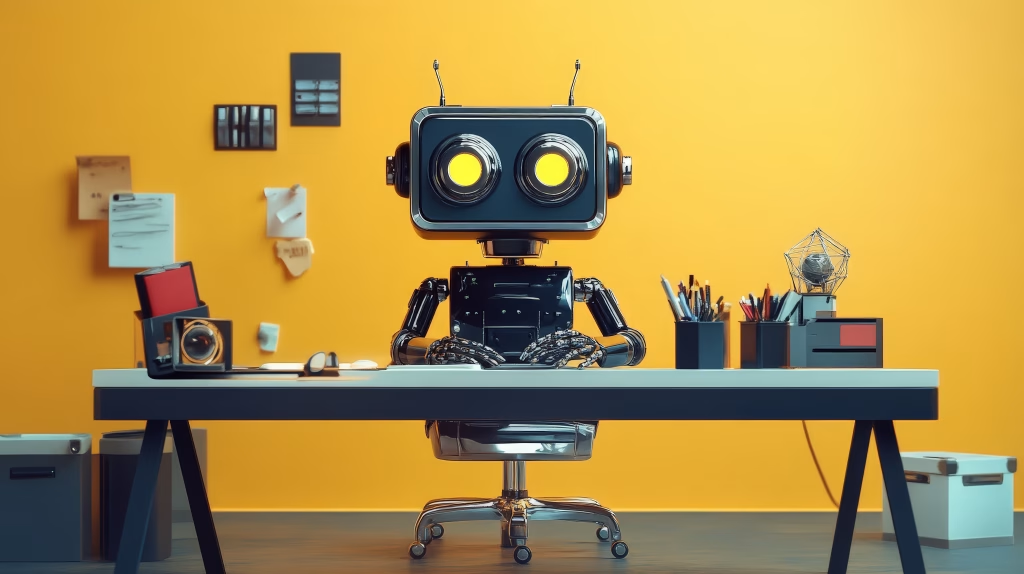
AI is already reshaping creative work across different areas, from writing itself to the way content is planned and structured.
Copywriting
Let’s take copywriting as an example. AI has made it significantly easier to generate drafts, variations, and ideas, so a writer no longer starts from a blank page but from something that already resembles a finished piece.
That “small” improvement changes the workflow entirely.
Instead of spending most of the time producing content, copywriting in the age of AI means you spend more time evaluating and editing it. The role shifts from writing everything yourself to guiding the process toward a better outcome.
The people who get the best results are not the ones who rely on AI the most, but the ones who know how to direct it.
Content Writing & Strategy
The same pattern shows up in content strategy. AI can analyze large amounts of information quickly. It can suggest topics, group keywords, and surface patterns in search behavior. That makes it easier to build structured content around real demand instead of assumptions. But the strategy itself still requires judgment.
As more teams use AI to produce content, the baseline level of quality rises. It becomes easier to create content that is technically correct, well-structured, and optimized for search.
But at the same time, if everyone is producing “good” content, it becomes harder to stand out. What starts to matter more is perspective, real experience, and a point of view that isn’t just assembled from existing information.
Search engines are already moving in that direction. Guidance from Google increasingly emphasizes helpful, experience-driven content over generic output. That’s a strong signal of where things are going.
When everyone has access to the same tools, execution becomes less of a differentiator. What starts to matter more is taste. The ability to choose what fits, what feels right, and what actually supports the message.
When we look at it from another perspective, AI is raising the standard by making the average better. And when the average improves, the only way to stand out is to be more intentional.
From Creation to Curation
Not long ago, being creative meant starting from nothing and building something from scratch. Now, more often than not, you’re starting with something already generated and shaping it into something better.
That shift sounds small, but it changes many things.
Creative work is becoming more about deciding what stays, what goes, what gets refined, and what needs to be changed entirely. The real value is no longer in writing the first version but in recognizing what works for your goal.
In that sense, creative direction becomes more important than the execution.
The ability to guide, edit, and refine content is what separates average output from something that connects.
Everything Starts to Sound the Same

There’s a downside to all of this, and it’s already visible, as AI tends to smooth things out. It makes the tone neutral and average, and the same goes for structure, and phrasing. The more people are using AI without strong human input, the more content starts to feel similar and interchangeable.
You are probably already seeing this online: articles that are technically correct, well-structured, well-phrased, but completely forgettable. Visuals too.
But this is not an AI problem (well, for the most part); it’s a lack of direction. If the input is generic, the output will be too.
When the barrier to content creation, or any creative execution, decreases, differentiation has to come from somewhere else.
In practice, that means being intentional about how your content sounds and what it stands for. Not just visually, but in language, tone, and perspective. It also means being willing to push beyond safe phrasing and expected perceptions.
AI can help you get started, but it should never be the final layer. That last layer has to come from a human perspective, shaped by real experience and opinion.
So, How Creative Is AI, Really?
The answer to this question is simpler than it sounds.
AI is very good at producing content that fits within known patterns. It can generate ideas, structure information, and adapt tone quickly. It’s fast, consistent, and surprisingly useful in early stages of creation.
But it doesn’t have human intent, it doesn’t have lived experience, and it doesn’t know why something matters beyond the data it has seen.
This is why the output AI produces sounds complete but not memorable. Creativity, in the sense that it actually moves people, still comes from context, judgment, and perspective.
What This Means for Digital Marketing Teams
If you’re working in digital marketing consulting, this shift is already showing up in how teams operate, but the biggest change is not in tools but in expectations.
Basic content production is no longer the most time-consuming task. You can generate drafts, variations, and ideas almost instantly with an LLM agent. What is harder and more valuable is making sense of all that AI output.
Teams that adapt well in this environment will sharpen a different set of strengths, such as strategic thinking, understanding your audience, and editorial judgement.
At the same time, certain tasks are already starting to lose their weight. Writing a first draft is no longer the hard part. Repetitive content production becomes less valuable on its own. The focus shifts toward shaping, reshaping and aligning content with real business goals.
You can already see new hybrid roles forming around these changes. People who are not just writers or marketers, but operators. They know how to work with AI, but they also know when to ignore it. They understand systems, but they also understand nuance.
A Practical Way to Use AI Without Overdoing It
The easiest way to think about AI is not as a replacement but as a layer in your process. A tool to explore ideas, generate angles, and break through the blank page problem. AI can help you move faster in the early stages, and you build from there.
After that, you step in to question what was generated, remove what feels generic, and push the content into something more specific and grounded. This is where you utilize the human experience, through examples, opinions, and subtle decisions that AI simply can’t make.
Finally, you refine. Not just for grammar or flow, but for clarity and intent. You shape the content so it aligns with your brand, your audience, and the outcome you actually want.
This layered approach is where AI becomes useful and actually helps you be more creative with your work.
Final Thought
Most creators are not running out of ideas. The real shift is in how those ideas are developed, refined, and brought to life.
AI introduces a new layer of leverage, but it also raises a new challenge: deciding what is worth creating in the first place.
This is where many people get stuck. When creation becomes easier, the volume increases, but clarity often decreases. The bottleneck is no longer skill or tools, but judgment.
The real advantage will not come from using AI more but from using it with intention. Knowing when to rely on it, when to step back, and how to shape its output into something meaningful.
This is where having the right content strategy matters. Whether you are a brand, a team, or an individual creator, the goal is not just to create more and faster, but to create work that resonates, connects, and inspires.
If you want to use AI to your content’s advantage, while maintaining a clear creative direction, a team like Ginger IT Solutions can make a real difference. With a clear strategy and strong copy, the focus shifts from output to impact, helping you use AI in a way that supports your voice instead of diluting it.
AI will continue to evolve. Tools will improve. Outputs will get better. But one thing will remain constant: not everything created will matter equally. The real difference will come from what you choose to create and how you choose to create it.