


After a decade in the industry, one pattern becomes difficult to ignore. In most campaigns, a small share of actions drives the majority of results. A handful of pages brings in most of the traffic. A limited set of keywords generates most conversions. Everything else tends to fill dashboards and create a sense of progress that does not translate into growth.
Have you ever looked at an SEO report packed with activity and wondered how much of it actually moved the needle?
This is where the Pareto principle comes in. At its core, the idea is simple: around 80% of outcomes come from 20% of inputs. While this pattern shows up across many fields, it has become especially visible in SEO.
The takeaway is not subtle. Results are uneven, and the problem is rarely a lack of work. It is a lack of prioritisation. Many strategies still follow a “cover everything” mindset, with more content, more keywords, and more technical tweaks. The outcome is often diluted focus and slower growth.
A more effective approach starts with a simple question: which 20% is actually driving rankings, traffic, and revenue?
That is the focus here. This article breaks down where the real leverage sits, how to identify it using real data, and how to apply the Pareto principle to build an SEO strategy that delivers meaningful results without unnecessary complexity.
What Is the Pareto Principle?
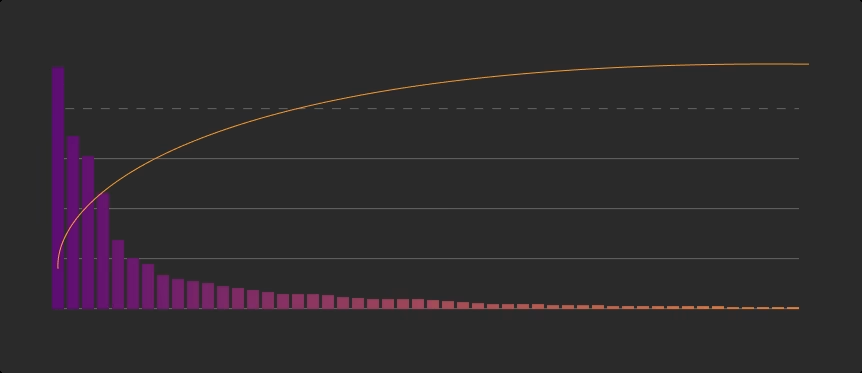
The Pareto principle, often called the 80/20 rule, is the idea that a large share of results tends to come from a relatively small share of inputs. In simple terms, roughly 80% of outcomes are driven by 20% of actions.
Although originally observed by economist Vilfredo Pareto, the concept was later formalized and popularized by quality management expert Joseph Juran. Pareto noticed that about 80% of land in Italy was owned by 20% of the population.
Over time, this pattern continued to appear across different contexts, including business, economics, and productivity research.
It becomes easier to understand when you step away from business for a moment. Think about a typical wardrobe. Most people wear a small portion of their clothes most of the time, while the rest stays unused. The same imbalance applies to work, decisions, and performance.
In practice, the Pareto principle is a prioritization tool. It helps filter decisions by separating what drives results from what simply fills time. It also highlights diminishing returns, where additional effort produces progressively smaller gains.
A simple way to visualize this is with a Pareto chart. You list contributing factors, rank them by impact, and plot their cumulative contribution. The result is usually a steep curve, where a few factors account for most of the outcome, while the rest contribute only marginally.
What Is the Pareto Principle in SEO?
Open almost any analytics dashboard and the pattern reveals itself quickly. A small group of pages, often around 20%, quietly carries the entire site. A few keywords bring in most of the leads. A limited number of backlinks does most of the heavy lifting.
That is the Pareto principle in SEO.
It matters more now because search is more competitive and less forgiving. Content volume has increased, largely driven by AI, but value has not kept pace. At the same time, search engines are placing greater weight on relevance, authority, and usefulness. With limited crawl budgets and shorter attention spans, average content fades quickly.
Publishing more content does not guarantee growth. Building more links does not guarantee authority. Even a technically flawless site will struggle without clear focus.
The Pareto principle offers a different lens. It shifts the focus toward identifying high-impact opportunities and allocating resources accordingly.
One nuance is worth keeping in mind. The ratio itself is not fixed; it may be 70-30 or 90-10, depending on the site, industry, or stage of growth.
Where the Pareto Principle Shows Up in Real SEO Data

The Pareto principle stops being theoretical the moment you look at real data.
Open Google Search Console or GA4 on any established site and the pattern is clear. Dozens of pages may be published, but only a small number consistently drive traffic. From those, even fewer generate leads or revenue.
1. Traffic Concentration
Research from Ahrefs shows that a large percentage of pages receive little to no traffic from search.
In practice, it often plays out like this. One page starts ranking, earns links, and keeps bringing in traffic over time. Meanwhile, dozens of others sit quietly with minimal impressions.
When you examine top-performing pages closely, consistent patterns begin to appear:
- Clear alignment with search intent
- Strong internal linking support
- Topics with sustained, ongoing demand
The goal is to understand why some pages break through while others do not.
2. Keyword Distribution
Traffic alone can be misleading, because not all keywords carry the same value.
High-intent queries, often with lower search volume, tend to drive most conversions. These are searches where users are ready to act, not just explore.
In practice, this often looks like a split. A blog post may rank for thousands of informational keywords and bring steady traffic. A service page may rank for far fewer queries but generate most of the leads. Both play a role, but they deliver different outcomes.
The key is to segment keywords by intent, not just volume. Without that, it is easy to chase traffic and miss what actually drives results.
3. Link Equity
Link building still matters, but what drives results has changed.
It is not about whether links work, but which ones actually influence rankings. Editorial links from relevant, authoritative sites carry significantly more weight than bulk placements. A single strong link can lift an entire cluster of pages and improve visibility across multiple keywords.
This reflects how search engines assess trust and authority. Large-scale studies, including Backlinko’s, also show a strong correlation between referring domains and higher rankings, reinforcing the importance of quality over volume.
This is where many campaigns lose efficiency. It is easier to count links than to measure their impact, so strategies often drift toward quantity. In reality, the value of a link comes from its context, relevance, and placement.
4. Technical Impact
Technical SEO can quickly become a long checklist, but not all technical issues matter equally. A single problem can hold back large parts of a site, and fixing it can unlock growth immediately.
Common high-impact issues include:
- pages blocked from indexing
- poor internal linking that restricts crawlability
- slow-loading templates affecting entire sections
These are not minor fixes. They are structural issues that can impact dozens of pages at once.
A Pattern Worth Acting On
Across all of these areas, one thing stands out: results tend to concentrate around a small set of pages, keywords, links, and decisions.
The mistake is assuming everything carries equal weight. It does not. Some elements consistently drive performance, while others have little impact. The goal is to identify those high-impact pieces and treat them as assets worth investing in.
Start by looking at what is already working. Understand why it performs well, then build on it. In practice, that usually means less time creating from scratch and more time improving, connecting, and strengthening what already delivers results.
The 20% That Drives 80% of SEO Results

Once the pattern is clear, the next step is action. The same elements that dominate performance in your data are the ones worth doubling down on.
High-Intent Keyword Targeting
Not all keywords deserve equal attention. Keywords with commercial or transactional intent drive real outcomes. These are searches where the user is no longer exploring, but deciding. Phrases like “cost,” “near me,” “service,” or “best provider” often signal this intent.
A common mistake is chasing search volume. A more effective approach is to focus on:
- queries already generating leads
- SERPs dominated by service or product pages
- keywords competitors treat as revenue drivers
The shift is simple: from what brings traffic to what drives results.
Topical Authority Pages
Search engines have become much better at understanding context, so they reward depth and relevance, not just publishing frequency. Pages that clearly and thoroughly answer real queries tend to perform better over time.
If a few pages already drive most of your traffic, they should be expanded, not left as they are. In practice, this means:
- turning high-performing pages into deeper, more complete resources
- building supporting content around them
- strengthening internal links
A strong pillar page, supported by related content, sends a stronger signal of authority and creates a clear structure around a topic. Over time, it compounds in value as it earns links, gets updated, and gains visibility.
Strategic Link Building
If a small number of links drives most authority, your strategy should reflect that.
Focus on:
- relevance over reach
- editorial placement over quantity
- context over raw numbers
A simple way to evaluate a link:
- Would it make sense even without SEO?
- Is it placed within relevant, contextual content?
- Does it come from a trusted site?
If the answer is yes, it is likely part of that critical 20%.
High-Impact Technical SEO
Not all technical fixes deserve the same level of attention. Some have minimal impact, while others can improve performance across large parts of a site.
The goal is to focus on changes that deliver the most impact with the least effort.
Prioritize fixes that:
- affect multiple pages, not just one
- improve crawl efficiency and accessibility
- strengthen pages that already have visibility
High-impact areas typically include:
- indexing and crawlability issues
- page speed and Core Web Vitals
- internal linking structures
Timing matters. Improving pages that already rank often delivers faster results than optimizing pages with no visibility.
What This Means in Practice
The 20% that drives results is rarely hidden. It is already visible in the data. The challenge is recognizing it and staying focused on it.
In practice, that means:
- investing more in top-performing pages
- prioritizing keywords tied to revenue
- focusing on fewer, stronger links
- fixing issues that impact entire sections of the site
The shift is subtle, but the impact is significant.
Why Most Teams Struggle to Focus on the 20%
At this point, the pattern is clear. The high-impact areas are visible, and the next steps seem obvious. Yet many teams still spend most of their time on low-impact work.
The issue is rarely a lack of knowledge. It is pressure.
SEO rarely operates in isolation. It sits between marketing, product, leadership, and sometimes sales. Each brings its own expectations, often pushing for more content, more keywords, and more visible activity. Over time, the focus shifts from impact to output.
A common scenario looks like this. Data shows that a handful of pages drives most results. The logical move is to improve and expand those pages. Instead, teams are pushed to publish new content or target additional keywords just to “keep things moving.” Effort becomes scattered, while key drivers get less attention.
This is where the Pareto principle becomes difficult to apply, because it requires saying no.
- no to content that does not build on existing strengths
- no to keywords that do not support business outcomes
- no to tasks that look productive but deliver little impact
At this point, focus stops being just an analytical decision. It becomes a strategic one.
How to Apply the Pareto Principle in SEO: Step-by-Step Guide

Most teams understand the Pareto principle in theory. Far fewer apply it consistently.
The issue is not a lack of knowledge. It is that everything starts to feel equally important. SEO rarely fails from a lack of ideas, but from unclear priorities and poor sequencing.
Applying the Pareto principle means making deliberate decisions: what to focus on next, and what to deliberately ignore.
1. Run a Focused SEO Audit
Start with data, but use it to find leverage. Instead of auditing everything equally, narrow your focus on three areas:
- pages already attracting meaningful traffic
- keywords already driving conversions
- pages ranking just outside top positions (typically positions 4-10)
A common mistake is treating the site as a blank slate. It isn’t. Some pages are already closer to success. The goal is to identify them.
Look for patterns:
- What type of content performs best?
- Which topics attract both traffic and engagement?
- Where does intent align with outcomes?
These patterns reveal existing momentum and show where to focus next.
2. Double Down on What Already Works
Once you identify high-performing assets, focus on strengthening them.
Many strategies lose efficiency by moving on too quickly, chasing new topics instead of strengthening existing wins.
In practice, this means:
- expanding content that already ranks
- improving clarity, depth, and structure
- strengthening internal links around proven pages
The logic is straightforward. It is easier to move a page from position 6 to position 2 than to rank a new page from scratch.
There is also a compounding effect. Pages that already perform tend to attract more links, engagement, and visibility over time. Strengthening them accelerates that growth.
Understanding Diminishing Returns in SEO
Not all SEO efforts deliver equal results. In most cases, the return curve looks like this:
- the first 20% of effort drives the biggest gains
- the next 20% brings smaller improvements
- the remaining 60% consumes time with minimal impact
You can see this in practice. Moving a page from position 8 to 4 is often achievable. Moving from position 3 to 1 usually requires far more effort for a much smaller gain.
3. Eliminate or Consolidate Low-Value Content
Most sites carry content that adds little value. Thin pages, outdated articles, and overlapping topics dilute authority and make it harder for search engines to understand what matters.
This is where the Pareto principle requires discipline. Not everything deserves to be improved. Some things should be removed or merged.
Focus on:
- consolidating similar pages into stronger, unified content
- removing outdated or irrelevant pages
- tightening content structure to reduce fragmentation
The result is not just a cleaner site, but clearer signals and stronger overall performance.
4. Prioritize High-Impact SEO Tasks
Not all SEO tasks deserve equal attention, even if they sit on the same checklist.
Focus on actions that deliver the most impact:
- Does this affect multiple pages or just one?
- Does it improve pages that already rank?
- Does it remove a real barrier to growth?
High-impact tasks typically include:
- fixing indexing and crawl issues
- improving site speed at a template level
- optimizing pages with existing visibility
Opportunity cost matters. Every hour spent on low-impact tasks is time not spent on high-leverage ones.
A Smarter Way to Think About Execution
The Pareto principle is best understood as a framework for decision-making. It shifts the focus:
- from activity to impact
- from volume to leverage
- from “what can be done” to “what is worth doing now”
The most effective SEO strategies are not the busiest. They are the most selective.
Measuring the 20% That Drives SEO Results

The 80-20 rule works as a filter for measurement. Focus on impact, not activity.
To turn data into decisions that reflect outcomes and measure SEO effectively, prioritize metrics that connect directly to results:
- conversions and revenue from organic traffic
- performance of top pages that drive outcomes
- keyword rankings tied to commercial or transactional intent
These may move slower than overall traffic, but they are far more reliable indicators of growth.
Another important shift is how performance is evaluated over time. The “top 20%” is not fixed. Pages gain and lose traction, so regular analysis is essential.
A useful approach is to track contribution, not just totals. Instead of asking how much traffic the site generates, look at which pages drive most conversions. Instead of tracking all keywords, focus on those that consistently bring in qualified users.
Conclusion
SEO success rarely comes from doing more. It comes from focusing on what matters and refining it over time.
Most teams are not short on ideas or effort. The real challenge is prioritization, deciding what deserves attention and what does not.
The Pareto principle offers a clear way forward. It is not a rigid formula, but a way of thinking. Identify what works, invest in it, and reduce or remove the rest.
This is often the point where many businesses hit a ceiling. Everything seems active, yet progress slows. That is usually a sign that the issue is no longer execution, but clarity.
Most businesses don’t need more SEO work. They need better decisions. That’s where the right SEO agency, like Ginger IT Solutions, makes the difference.
An experienced team focuses on what actually drives rankings, traffic, and revenue by aligning SEO with business goals, identifying high-impact opportunities, and avoiding the kind of busywork that looks productive but delivers little.
Search will continue to evolve. Algorithms will shift. New tools will appear. But one thing stays consistent: results are not evenly distributed.
The advantage goes to those who recognize that and act on that.
Focus less. Prioritize better. Let the results follow.