



Web design cost in 2026 is a revenue decision, not just a design decision. The right website reduces acquisition costs, improves conversion rates, and strengthens operational efficiency. The wrong one becomes an expensive placeholder that quietly drains your budget.
It is no surprise that one of the first questions potential clients ask during initial consultations is, “How much does a website cost?” It is a fair question. It is simply not the most important one.
A better question is: what role should the website play in business growth? Should it generate qualified leads, support sales teams, integrate with internal systems, and drive organic visibility at scale? Or simply exist as an online presence?
There is no universal price tag because there is no universal objective. A performance-driven platform built to convert and integrate carries a very different website development cost than a basic informational site. Scope, strategy, and performance expectations define the investment.
A website is business infrastructure. Just as startup costs vary by industry and ambition, website creation price varies according to complexity and long-term goals.
This guide breaks down how much it costs to design a website in 2026, what drives website development pricing, and how experienced business owners should evaluate web design cost through a strategic lens rather than a reactive one.
Quick Summary
Custom website design cost in 2026 typically ranges from $3,000 to $70,000+, with enterprise-level platforms often exceeding six figures depending on scope and integrations.
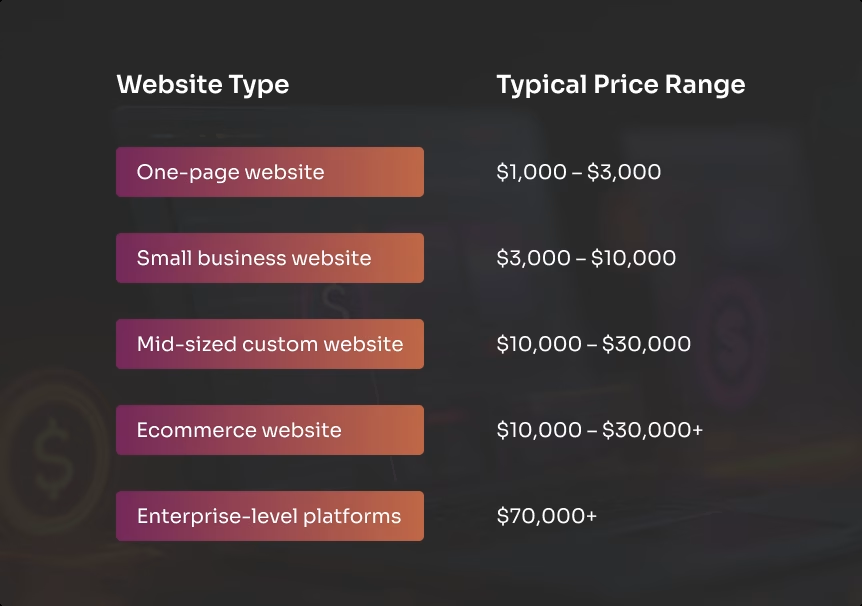
Below is a realistic breakdown based on project type:
- One-page website: $1,000 – $3,000
- Small business website: $3,000 – $10,000
- Mid-sized and complex website: $10,000 – $30,000
- Ecommerce website: $10,000 – $30,000
- Enterprise-level platforms: $70,000+
Website Cost by Business Type (2026 Overview)
Definition of Web Design Cost
Web design cost is often misunderstood as the price of visual styling. In reality, it reflects the entire process required to plan, design, develop, and launch a high-performing digital platform.
It includes the visible layer, such as layout, typography, brand alignment, and interface design. It also includes the structural and technical architecture that users never see but constantly experience. Information architecture, user journey mapping, performance optimization, integrations, security configuration, and CMS implementation are all part of the equation.
In other words, website design cost is not limited to how the website looks. It encompasses how it functions, how it loads, how it integrates with business systems, how it ranks in search engines, and how it converts visitors into customers.
What businesses are investing in is not a collection of pages, but a structured digital asset built to support marketing, operations, and revenue growth.
Web Design Cost: What You’re Actually Paying For

Search data shows that most business owners searching for:
- How much does a website cost?
- How much does it cost to build a website?
- How much does website development cost?
What they are looking for is a single number. What they actually need is context.
A template-based build and a fully custom solution delivered by a professional web design agency operate in completely different categories. The difference is not aesthetic; it is structural.
Website development cost typically includes:
- Strategic planning and discovery
- UX architecture and user journey design
- Custom UI design aligned with brand positioning
- Front-end and back-end development
- SEO-ready technical infrastructure
- Performance optimization
- Security configuration and compliance
Online pricing ranges often group very different project types into one simplified bracket. A five-page informational website cannot be compared to an integrated ecommerce platform with advanced filtering, automation, and CRM integration.
Website development pricing ultimately reflects three things: business objectives, technical complexity, and growth trajectory. Once those are clearly defined, the numbers start to make sense.
The 7 Core Factors That Drive Website Design Cost
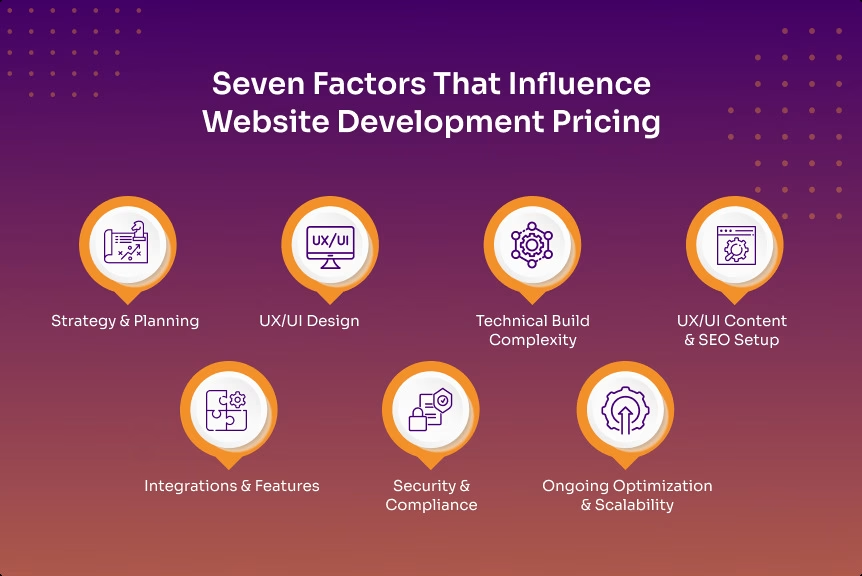
Website design cost is determined long before launch. It is shaped by strategic choices around functionality, integrations, performance expectations, and long-term goals.
Below are the seven core factors that influence website development pricing in 2026:
1. Strategy and Planning
Strategy and planning define what the website is expected to achieve and how it will achieve it.
This phase typically includes:
- Market research
- Competitive analysis
- Customer journey mapping
- Information architecture
- UX planning
Positioning is clarified during this phase, messaging hierarchy is structured, and conversion paths are mapped.
When discovery is rushed or skipped, conversion rates typically suffer, even if the website looks modern. Visual appeal alone cannot compensate for weak strategy.
2. Custom UX/UI Design

Professional UX/UI design goes far beyond visual styling. It involves:
- Wireframes that define structure
- Design systems that ensure consistency
- Fully responsive layouts
- Brand integration across all touchpoints
- Accessibility compliance
Research confirms users form impressions in milliseconds. Layout clarity, navigation logic, and usability directly influence trust.
Custom UX increases web design price because it is built around real user behavior and clear business objectives. When design aligns with user intent, friction decreases and conversions improve.
3. Development Complexity
Technical build cost often scales rapidly at this stage.Development complexity depends on:
- CMS selection
- Custom functionality requirements
- API integrations
- User dashboards
- Advanced search and filtering
- Booking systems
- Ecommerce website development cost variables
- Multi-language architecture
Each additional feature requires planning, development, testing, and maintenance.
Ecommerce projects illustrate this clearly. Baymard Institute reports that average cart abandonment exceeds 69%. Checkout friction, loading speed, and UX flow directly affect revenue.
4. Content and SEO Foundation
Website creation price should account for SEO infrastructure from the beginning. This includes:
- Structured data implementation
- Clean URL architecture
- Core Web Vitals optimization
- On-page hierarchy and semantic structure
- Internal linking logic
Google continues to emphasize that strong performance and a positive user experience remain central to search visibility. Fast, well-structured websites that prioritize clarity and usability are more likely to perform well in search and convert visitors consistently.
Retrofitting SEO after launch often increases website development cost, since structural changes are usually required to correct issues that could have been addressed from the start.
5. Integrations and Features

Modern businesses operate through connected systems. Websites frequently integrate with:
- CRM platforms
- Marketing automation systems
- Payment gateways
- Inventory management software
- Membership portals
Each integration adds development time and complexity, which influences web site development price. At the same time, these integrations reduce manual processes, improve data accuracy, and support automation.
The question is not whether integrations increase web design cost. It is whether operating without them creates inefficiencies that cost more.
6. Security and Compliance
Security is not optional infrastructure – it is foundational. Professional website development pricing includes:
- SSL setup
- Secure hosting
- Regular updates and patch management
- GDPR compliance
- Data protection safeguards
IBM’s annual data breach reports consistently show that recovery costs far exceed prevention costs.
Security failures erode trust and damage reputation. Building secure architecture from the start is a financially sound decision and a standard part of responsible website development pricing.
7. Ongoing Maintenance and Scalability
Website development cost does not end at launch. Ongoing investment typically includes:
- Performance monitoring
- Software updates
- Feature enhancements
- Conversion rate optimization
- Analytics refinement
Businesses that treat their websites as evolving systems consistently outperform those that treat them as fixed, one-time projects. Continuous optimization compounds results over time.
Once these factors are clearly defined, website design cost becomes a calculated investment grounded in performance, scalability, and long-term growth.
Website Cost by Business Type

In 2026, website pricing depends less on page count and more on what the business is built to achieve. Ambition, revenue model, growth plans, and operational complexity shape the investment far more than layout alone.
That said, standard price ranges are still typically defined by scope of work. Functionality, integrations, performance requirements, and technical depth determine website development cost. When viewed through this lens, pricing becomes clearer and comparisons between different business types more meaningful.
1. 1 Page Website Development Cost
A one-page website is often labeled as “simple,” but in reality it is highly focused and performance-driven. It condenses awareness, trust-building, and conversion into a single structured journey.
Single-page websites are typically used for paid advertising funnels, product launch microsites, early-stage validation projects, and personal brand positioning. In most cases, they are built around one clear objective:
- Lead generation
- Product validation
- Campaign support
- Event promotion
- High-ticket service funnels
Because there is only one page, every section must move the visitor toward action. Messaging hierarchy, visual sequencing, and CTA placement must be deliberate. There is no room for distraction.
The web design cost for a one-page website generally ranges between $1,000 and $3,000, depending on conversion complexity and integration requirements.
At this level, website development cost reflects:
- Depth of research and planning
- UX structure and refinement
- Copy hierarchy and messaging strategy
- CRM or email marketing integration
- Analytics and performance tracking setup
A purely informational page with minimal integrations sits closer to the lower end of the range. A conversion-driven landing page with tracking, CRM synchronization, and custom UI elements approaches the upper end.
With no secondary pages to recover lost attention, execution must be precise. Every scroll should guide intent, with information flow, credibility signals, and persuasive elements working together seamlessly.
2. Small Business Website Development Cost
This tier primarily applies to service-based companies, local businesses, consultancies, and growing brands that rely on lead generation rather than direct online transactions.
At this level, the website functions as:
- A structured lead generation platform
- A credibility and brand authority asset
- A primary digital touchpoint for inquiries
A typical small business website includes:
- 10 to 25 structured pages
- Clear service architecture
- Dedicated landing pages for key offers
- Lead capture forms and inquiry funnels
- Blog or resource section
- SEO-ready technical foundation
These websites are built to attract, inform, and convert prospects, but they usually do not require complex integrations or transactional infrastructure.
Small business custom websites typically range from $3,000 to $10,000+. Pricing increases based on custom UX depth, content strategy, integrations, and performance requirements.
3. Mid-Sized and Ecommerce Website Development Cost
Mid-sized and ecommerce websites move beyond lead generation and into operational or transactional complexity. Here, the website becomes directly tied to revenue performance and system integration.
These projects typically involve:
- Ecommerce functionality
- Advanced filtering and search logic
- Custom checkout optimization
- User account systems
- API integrations
- Inventory synchronization
- Performance engineering for scalability
- Payment gateway and fraud protection systems
Mid-sized and complex builds, including ecommerce websites, typically range from $10,000 to $30,000+, depending on functionality and integration depth. This range most often applies to ecommerce platforms built with solutions like WooCommerce on WordPress.
Beyond that, fully custom ecommerce systems designed around unique business logic, advanced integrations, or high transaction volume often exceed $50,000 due to their architectural complexity and scalability requirements.
Unlike small business sites, ecommerce platforms operate as real-time transactional systems. They manage pricing rules, tax calculations, product logic, and user data continuously.
This is where web design cost and revenue are closely connected. Every click, every second of load time, and checkout interaction affects profitability. Improved conversion efficiency increases margins, while friction quietly reduces them. A well-architected ecommerce platform protects revenue and supports scalable expansion.
4. Enterprise Platform Development Cost
At the enterprise level, the website becomes part of the organization’s digital infrastructure, not just a marketing channel. It connects departments, systems, and global operations. That shift is reflected in the website creation price, which frequently exceeds six figures depending on scope and architectural complexity.
Enterprise platforms typically start at $70,000+, with larger implementations extending significantly beyond that based on integration depth and governance requirements.
Enterprise platforms commonly include:
- Multi-language and multi-region architecture
- Multi-location structures with regional governance
- API-driven or microservices-based architecture
- Deep CRM, ERP, and internal system integrations
- Headless CMS or composable architecture frameworks
In addition to large corporate platforms, enterprise-level ecommerce solutions often fall within this range as well. Custom-built online stores developed in Laravel, designed around unique business logic, complex product rules, advanced integrations, or high transaction volumes, frequently exceed $50,000 due to their architectural depth and scalability requirements.
In this context, an enterprise platform can absolutely be an ecommerce system, especially when it operates as mission-critical infrastructure rather than a simple storefront.
These builds require cross-department coordination, strict governance protocols, advanced security controls, and long-term scalability planning. Performance, compliance, data integrity, and system interoperability are mandatory.
At this level, website design cost aligns directly with digital transformation strategy rather than standalone marketing execution.
With these pricing tiers defined, the next step is understanding how website development cost differs from the initial website price and what that means for total investment over time.
Website Development Cost vs Website Price

Website price is the invoice you receive. Website development cost is the investment you carry over time.
The initial website price typically covers the build itself. True website development cost reflects everything required to make that platform perform, evolve, and generate returns after launch.
A realistic total investment includes:
- Strategic planning and positioning
- UX and visual design
- Front-end and back-end development
- Hosting and infrastructure
- Security configuration
- Technical SEO foundation
- Ongoing optimization and updates
Focusing only on the upfront website price often leads to compromises. Those compromises usually resurface as technical debt, performance issues, or structural limitations. Rebuilding within two years frequently costs more than building correctly from the start.
Experienced business owners do not evaluate website design cost emotionally. They measure it against performance outcomes such as:
- Conversion rate improvement – through clearer user journeys, faster load times, and stronger calls to action that increase the percentage of visitors who take action.
- Reduced customer acquisition cost – by improving on-site conversion efficiency so paid traffic generates more results from the same budget.
- Higher-quality leads – by aligning messaging, structure, and intent so inquiries are better qualified and closer to purchase decisions.
- Lower dependency on paid media – by strengthening SEO foundations and organic visibility, reducing reliance on ongoing advertising spend.
Website development pricing should prioritize long-term efficiency and compounding value over short-term savings.
Why Partner with Ginger IT Solutions for Custom Web Design
Execution alone no longer sets a website apart. Strategic alignment does. That is what separates average websites from high-performing platforms.
In 2026, a website shapes marketing outcomes, sales efficiency, brand perception, and even internal workflows. With that level of influence, isolated design or development work is not enough. It requires coordinated expertise aligned around clear business goals.
Businesses that partner with web design experts who treat website development as infrastructure rather than decoration build stronger operational foundations. Ginger IT Solutions operates as a specialized web design agency that prioritizes scalability planning, governance standards, and long-term technical direction.
At Ginger IT Solutions, web design cost reflects this integrated mindset. As a professional web design agency, the focus is not on assembling pages but on building scalable digital systems structured for long-term performance.
Our web design services combine:
- UX and UI design grounded in real user behavior
- Custom development aligned with business logic
- Strong technical SEO foundations from day one
- Performance optimization aligned with Core Web Vitals
- Strategic planning connected to growth objectives
Designers, developers, and SEO specialists collaborate under a unified roadmap. Strategy shapes design. Design informs development. Development supports performance and visibility. Each layer reinforces the next.
The result is not simply a finished website, but a digital asset designed for measurable performance. Clients who implement a strong technical SEO foundation from the beginning often experience noticeable improvements in organic visibility within the first few months after launch. When the foundation is built correctly, performance improves steadily.
An important distinction: no prebuilt templates are used in our process. Every website is custom-built to reflect brand positioning, functional requirements, and performance goals. That approach naturally influences website development pricing, as custom architecture demands deliberate planning and precise execution.
At the same time, we take on selected budget-conscious projects when they align with our values, particularly when supporting local communities or small businesses with strong ideas and long-term potential.
Web Design Cost and ROI
Serious decision makers evaluate website development cost through metrics that directly influence revenue and profitability, such as customer acquisition cost, lifetime value, conversion rate, organic traffic growth, and average order value.
What is often overlooked is the compounding effect of small performance gains. A 1-2% increase in conversion rate may appear modest in isolation, but across consistent traffic volumes, that improvement can significantly increase annual revenue without increasing advertising spend. The same applies to load speed improvements that reduce bounce rates or structural refinements that shorten the sales cycle.
A higher web site development price can therefore reduce marketing inefficiencies by improving conversion performance, shortening decision paths, and lowering wasted ad spend. Over time, this shifts the economics of customer acquisition.
How to Evaluate Website Development Pricing Proposals

Not all proposals are equal, and two quotes with similar website prices can lead to entirely different outcomes. Before approving a website development pricing proposal, ask the questions that protect your investment:
1. What is included in discovery?
Discovery defines strategy, structure, and user flow. If it is shallow, performance usually is too.
2. Is technical SEO embedded from the start?
Adding SEO later increases website development cost. It should be built into the architecture from the start, not treated as an add-on.
3. Who owns the code and assets?
Ownership affects flexibility, scalability, and long-term control.
4. What does post-launch supportlook like?
A website requires updates, monitoring, and performance refinement. Clarify what happens after launch.
5. How are revisions and scope changes handled?
Transparent processes reduce friction and unexpected costs.
Compare deliverables, depth, and long-term value, not just total website price. The lowest number often hides the highest future cost.
Frequently Asked Questions About Web Design Costs
1. How much does web design cost in 2026?
Custom professional projects typically range from $3,000 to $70,000+, depending on scope, integrations, performance requirements, and long-term objectives.
2. How much does it cost to design a website for a small business?
For small businesses, website development cost generally falls between $3,000 and $10,000 for lower-complexity builds.
3. What affects ecommerce website development cost?
It depends on how efficiently the platform converts and operates. Checkout optimization, product filtering, payment integrations, inventory sync, and performance engineering all increase technical complexity.
4. How much is the cost of a 1 page website?
A professionally built one-page website typically ranges from $1,000 to $3,000, depending on scope and conversion complexity.
5. Should you use a website builder or hire a web design agency?
If scalability, performance, and long-term ROI matter, partnering with a professional web design agency is the stronger choice. Custom architecture offers flexibility, integration capability, and strategic alignment that template-based solutions rarely provide.
6. How long does it take to build a website?
The timeline depends on scope and complexity. Smaller projects can take several weeks, while mid-sized custom builds typically require two to three months. More complex or enterprise-level platforms may take several months to complete.
Final Thoughts
Page count alone does not define web design cost in 2026. Strategic intent does.
At its core, a website investment reflects digital ambition and long-term direction. When business owners ask how much a website costs, the more relevant question is how it will support future growth. Website development pricing should align with revenue objectives and measurable outcomes, not just immediate budget limits.
Businesses that partner with web design experts build operational strength rather than temporary solutions. When executed with clarity and precision, a custom website does more than represent a brand. It strengthens long-term revenue performance.
A poorly planned website, on the other hand, often turns into an expensive reset, requiring a rebuild that could have been avoided. The decision is simple: invest in scalable performance now, or pay for corrections later?
Ready to evaluate your real website development cost? Let’s talk.